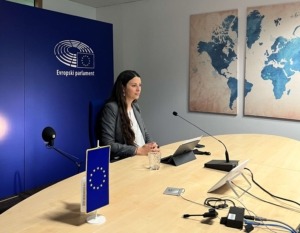
On Tuesday, 8 March 2022, MEPs discussed the situation in Bosnia and Herzegovina at a plenary session in Strasbourg. MEP Irena Joveva drew parallels between Dodik’s destruction of Bosnia and Herzegovina and Putin’s actions in Ukraine.
Joveva began by pointing out that, unfortunately, in the 21st century, autocrats and democracy destroyers still exist on European soil, threatening peace, human rights and fundamental freedoms:
“Thirty years after the war in Bosnia and Herzegovina, Milorad Dodik is destroying the country and its institutions. He denies genocide. As if what the people there have been through were not enough. Thirty years after the war in Bosnia and Herzegovina, a new war begins in Ukraine. Vladimir Putin is branded a criminal. And rightly so, because that is exactly what he is.”
Despite the EU’s immediate response to Putin’s actions, Joveva expressed concern that those of Dodik are noticed much less: “How can anyone fail to condemn his moves? Does his affiliation with some parties make him any less evil? The citizens of Bosnia and Herzegovina are no less deserving of a better life and leaders who care.” In her opinion, the citizens of BiH should be supported on their path to the European Union. “In the meantime, we must stand up – just as loudly –to all autocrats and criminals, because we have long seen too much hypocrisy of the European Union in this respect. Even within our own ranks. The methods are very similar. Unfortunately,” she concluded.
Joveva’s contribution to the plenary debate can be viewed on the link below:
https://www.irenajoveva.si/wp-content/uploads/2022/03/Brez-naslova.png7751501Aljaž Debeljakhttps://www.irenajoveva.si/wp-content/uploads/2024/05/vsi-logoti-glava1-newB_latest-300x99.pngAljaž Debeljak2022-03-08 10:07:512022-08-11 17:03:27“Autocrats and democracy destroyers still exist”
Today, on 24 November 2021, MEPs discussed fundamental freedoms and the rule of law in Slovenia, in particular the complications around the appointment of European Delegated Prosecutors.
“If you criticise, attacks will follow. Either there is subordination or destruction. Either you support this government or you must leave. Either you belong to them or — basically —be careful.” These are the words MEP Irena Joveva used to open her debate on Slovenia. She underscored that deviations from democratic norms reach beyond national boundaries and become a problem for the Union, as was illustrated by the examples of Poland and Hungary.
In October, a delegation from the Committee on Civil Liberties, Justice and Home Affairs of the European Parliament examined the state of the rule of law and democracy in Slovenia, and in particular expressed concern about the non-appointment of European Delegated Prosecutors and the non-payment of services provided by the Slovenian Press Agency (STA). “The current Slovenian Government has recently yielded to pressure, mainly from the EU. They released STA funding, after almost a year of manipulation. They took note of the names for the European Delegated Prosecutors, after more than a year of legal farce.’ But the MEP warned that the financial difficulties of the STA were not resolved, as the contract for next year has not yet been concluded. And in the case of prosecutors, she believed that the decision on temporary nomination made a mockery of independent institutions.
Joveva notes that the Government’s relenting is only feigned and that pressure has been mounting elsewhere. “There are attempts to subordinate, silence or smear the prosecutors, the judiciary, the police, the media, NGOs, the independent, and regulatory agencies. In this, they use all means available.” In the communication of the ruling structures there lurks the desire to destroy institutions, conspiracy theories about communists are used as a cover for corruption and clientelism. “This is not about defending traditional values. It is about negating them,” said the MEP. She concluded her address by asking:
“Our institutions have managed to withstand so far on account of a rich democratic tradition and the integrity of individuals. But for how much longer? Where are strong, specific responses? When will you learn that the situation in one Member State affects the whole of the EU?”
The Renew Europe group also expressed growing concern about the political situation in Slovenia. After half a year of delay, the Slovenian Government has now nominated two national prosecutors to the European Public Prosecutor’s Office (EPPO), operational since 1 June 2021. Nevertheless, the group remains deeply concerned about the Government’s political interference in the process of appointing the prosecutors. Prime Minister Janez Janša dissolved the previous appointment. The group wrote that it could not tolerate a Member State intervening and undermining the function of an EU judicial body. For that reason, the group’s Members request answers from the Slovenian authorities.
Unfortunately, this is not the only example of worrying backsliding on the rule of law, as was also pointed out by Joveva:
“The Government’s aggressive attempts to seize control over independent media and the Prime Minister’s attacks on journalists and political opponents on social media shows that press freedom and fundamental rights are also at risk. The European Commission must act to immediately stop the attempts of Janez Janša’s Government to politicise key democratic institutions and challenge press freedom.”
https://www.irenajoveva.si/wp-content/uploads/2021/11/Zajeta-slika-1.png6761197Nina Maurovičhttps://www.irenajoveva.si/wp-content/uploads/2024/05/vsi-logoti-glava1-newB_latest-300x99.pngNina Maurovič2021-11-24 12:14:032022-08-11 17:04:45“Either there is subordination or destruction”
On Tuesday, October 26, 2021, the Committee on Culture and Education held a discussion on the state of media freedom with European Commissioner Vera Jourova on the state of media freedom. In her introductory speech, the Commissioner placed Slovenia alongside Poland and Hungary and expressed concern about “numerous attempts to undermine the sustainability and independence of the Slovenian Press Agency (STA) and public media service”. MEP Irena Joveva shares this concern and highlighted growing political pressure on the media in Slovenia. She named several proposals for legislative solutions that could help protect journalists and increase media freedom.
It was emphasized by the MEP at the beginning that the current pressure on the media was unprecedented. She cited the need for an Anti-SLAPP directive as well as discussion on so-called exceptions to the rules for editorial media that should not, in her view, apply equally to all media. Thus, Joveva proposed the use of delegated acts to waive the rules for those media with de facto editorial independence, which would also provide a view into the media itself.
Regarding the act or law on media freedom that is being prepared, she proposed harmonizing the rules and legislation of the Member States and establishing a common framework for public media at EU level that would also provide controls and binding safeguards to endure media freedom. She believes that the solution is to create new EU bodies or committees, made up of regulatory agencies for media supervision or representatives of the press. This would provide protection for the media when things go wrong, as it currently does in Slovenia with the STA (Slovenian Press Agency). Also, she stressed the issue of advertising transparency, especially in advertising transactions when state-owned companies or state funds are involved. She also called for the protection of private media from suspicious takeovers, such as TVN in Poland. She sees the solution in enhanced democratic control over all takeovers, which could also prevent the concentration of media ownership.
Commissioner Jourova also agrees, noting that ownership concentration is a broader media problem in the European Union (she cited the current French situation), especially now during the pandemic, when smaller media are financially weak. According to the commissioner, ownership has a significant influence on the way journalists write and report.
The MEP considers it most important to introduce rules to protect journalists from their owners, boards of directors from political parties and the public media from political interference. She is convinced that conditions must be created to protect journalists, as only then can they exercise the right to free speech. It is paramount that the European Union gains true strength in terms of media protection, otherwise it can only silently observe events like Slovenia, where democracy is on the biggest test, the MEP concluded.In her response, Commissioner Jourova expressed particular concern about state-funded media, citing the example of the KESMA Foundation in Hungary. Such pro-government media report only certain information and, as a result, have a key impact on the outcome of elections. Furthermore, they present a distorted picture of the state of democracy.
The Commissioner also emphasized the responsibility of the media as a whole, which should first “clean up its own mess”. If we are to protect the media sector and journalists, we must be sure we are defending professionals with high integrity who do their job in the interest of protecting objective facts, Jourova said. She added that there is a clear requirement for member states to provide funding for public service broadcasting, again pointing out Slovenia as an example. Transparency and disclosure of media ownership was also a topic discussed by the Commissioner, as she felt it is important for people to know who stands behind them.
You can watch the video with excerpts from the Commissioner’s introductory speech and MEP’s Irena Joveva’s questions and Vera Jourova’s answers below:
https://www.irenajoveva.si/wp-content/uploads/2021/10/photo_2021-10-27_11-42-17.jpg7281280Nina Maurovičhttps://www.irenajoveva.si/wp-content/uploads/2024/05/vsi-logoti-glava1-newB_latest-300x99.pngNina Maurovič2021-10-27 12:46:402022-08-11 17:05:19Irena Joveva with Commissioner Vera Jourova on the state of media freedom
At the march plenary meeting MEPs discussed the outbreak of a new fast-spreading coronavirus (COVID-19) across Europe and the world, as well as the European Union’s response to it.
A number of MEPs during the debate on coronavirus have pointed out that solidarity and co-operation are crucial in Europe in the context of the coronavirus epidemic, which has spread to all EU Member States. Parliament has also heard some criticism at the expense of some countries and the European Union’s actions to date.
Irena Joveva pointed out that in a serious epidemic situation we do not need to panic, we must not be indifferent and we should not trust self-proclaimed experts.
Madam President! I am not going to say purely politically what we all have to do, because at this moment it seems more important for me to say what is wrong and what is superfluous. In my opinion, these are three different groups.
First: all panics are wrong and redundant. The new coronavirus is not the end of the world unless human stupidity prevails. I emphasize: if. Second: all indifference is wrong and redundant. Wouldn’t you still be indifferent if one of your parents or grandparents became infected?. I’m young. I would probably get over the virus, but what if I passed it on to someone who wouldn’t. That’s the point. It’s about responsibility. And third: self-proclaimed professionals are most wrong and redundant. All of a sudden everyone knows everything. In my opinion, self-isolation is necessary for these people as well, but from social networks in the first place.
The situation is absolutely serious, but who am I to condemn the measures. Are they too strict, too soft, too late? I do not know, but I know that I am responsible and I trust the profession. The real one.
https://www.irenajoveva.si/wp-content/uploads/2020/03/20200310_EP-101468B_MCU_257-1-e1584004480283.jpg27475551Jasna Gerbechttps://www.irenajoveva.si/wp-content/uploads/2024/05/vsi-logoti-glava1-newB_latest-300x99.pngJasna Gerbec2020-03-12 09:15:282020-03-12 09:15:28Would you still be indifferent if one of your parents or grandparents became infected?
“As you cannot throw all of us in the same bin, so you cannot these people! Come to the field. Among them. Bring it on.”
This is a (non-edited) part of one of my Facebook posts. It was October 2015. A time of severe humanitarian, refugee, migrant crisis.
In my previous life, as I usually say, field work was my love. Among many, exactly this one was most emotional, by far the most exhausting but also the most valuable. The field work taught me by far the most.
Four years and four months after my announcement, we discussed the humanitarian situation at the EU’s external borders at a plenary session in the European Parliament.
The video below is my part of the discussion where I ‘earned’ my first card. Not yellow, but blue. Intended to ask a question that you can then answer – if you do not reject the card. I accepted it. I probably don’t need to explain in particular that a Croatian colleague gave it to me. Because I have talked about how some people persistently reiterate that there is no evidence of any human rights violation on the border between Croatia and Bosnia and Herzegovina. That those of us who are loud in this regard are not telling the truth. Obviously I will need to be back in the field again. I went as a journalist, I will go as a politician if need with greater motivation. Because, next time they tell me again that there is no evidence, I’ll just be able to show them my own.
P.S.: In response, I invited the MP who had given me a card to take a look at the pictures, recordings and reports of events on the border that already exist. We’re probably going next week.
Dear President, for years, we have witnessed reports of human rights violations of refugees and migrants at the Union’s external borders. Among other things, as we have heard, also at the Croatian border.
Representatives of the EU Council Presidency, sitting in front, are representatives of Croatia, as well as colleagues from that country. I know what you would like to say again. That nothing is true, that there is no evidence …
A month ago, a group of NGOs released a report what happened there last year. The document shows that the Croatian authorities send these people back to Bosnia and Herzegovina with batons, with the result of air gun shots, barefoot, sometimes naked. Croatian Ombudsmen, United Nations agencies, and even some Croatian police officers in their anonymous statements, point to the occurrences.
The European Commission, in the previous composition, did what? Commission said Croatia was eligible for Schengen. So much for that. If necessary, I will personally go out into the field, but overnight and unannounced. Next time they tell me that there is no evidence, I will show you my recordings.
https://www.irenajoveva.si/wp-content/uploads/2020/02/Ijoveva-humanitarne-krize.png7151294Jasna Gerbechttps://www.irenajoveva.si/wp-content/uploads/2024/05/vsi-logoti-glava1-newB_latest-300x99.pngJasna Gerbec2020-02-15 10:02:142020-03-12 10:02:49If necessary, I will personally go out into the field
At the Committee on the Environment, Public Health and Food Safety, the Croatian Minister of the Environment and Energy, Mr. Tomislav Ćorić presented the program of the Croatian Presidency of the Council of the European Union in the field of environmental policy.
“I will speak in my native language, in Slovenian. Thank you very much for presenting your priorities, Mr. Ćorić. I’m here. The Commission has put Green Deal and tackling climate impacts among its top priorities in the current mandate. Croatia also included the Western Balkans as a priority during the Council Presidency. I wonder how the two seemingly different priorities would be combined? Because just these days, various organizations have published a survey that cities in the Western Balkans are among the most polluted in the world. There are several reasons for this, including poverty. Unfortunately. But to be specific. An important polluter in the Western Balkans is the 16 outdated thermal power plants that are polluting more than all 250 EU thermal power plants. As these countries still have a lot of coal in stock, they are announcing the construction of new thermal power plants with Chinese investment. I think that the EU should urgently, as much as possible, include countries in its immediate neighborhood in EU’s climate policy. Without clean air in the Balkans we will not have clean air in the EU. It also concerns your country Croatia, which is bordering these countries, and my country Slovenia, bordering on your country. I hope that the Croatian Presidency will also be able to address this aspect of EU policy in the Western Balkans. Thank you.”
https://www.irenajoveva.si/wp-content/uploads/2020/01/EOzN5gdXkAAzVEh-1-e1579858519203.jpg10951152Jasna Gerbechttps://www.irenajoveva.si/wp-content/uploads/2024/05/vsi-logoti-glava1-newB_latest-300x99.pngJasna Gerbec2020-01-24 09:06:162022-08-17 08:06:46An important polluter in the Western Balkans is 16 outdated thermal power plants