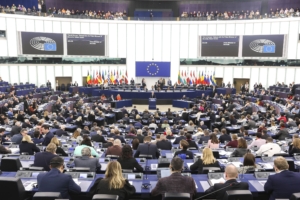
On Tuesday, 14 February 2023, MEP Irena Joveva spoke at the Strasbourg plenary session on the need for an independent EU ethics body. “I think it is now clear to everyone that there is no other way”, she said, stressing that without integrity, transparency, accountability and zero tolerance of corruption, there will be no trust in the work of MEPs.

She said that, while certain rules already exist, the different codes of conduct that the European institutions have put in place make standards uneven, investigative powers insufficient, and sanctions deficient and often unconvincing.

”It is true that in the end, it all depends on the integrity of every individual, but it is nevertheless right that we establish a European ethics body, with unified, clear rules of conduct within all institutions. And I hope these will be the strictest rules possible.”

She went on to point out that a majority in the European Parliament had called for the creation of the body two years ago, but unfortunately to no avail. At the same time, she expressed her hope that, especially given all the recent corruption scandals, the European Commission will finally follow through on its commitment made on that occasion and act on the European Parliament’s renewed request.

”I think it’s now clear to everyone that there is no other way. It certainly is to those of us who have no problem with rules and ethics.”

Background

On 15 December 2022, the European Parliament adopted a resolution on suspected corruption by Qatar and the wider need for transparency and accountability in the European institutions. On 16 September 2021, MEPs had already called on the Commission to come forward with a proposal to improve transparency and integrity in decision-making at the EU level. In today’s debate with the Council of the EU and the European Commission, MEPs reiterated their call for the establishment of an independent EU ethics body.

Its purpose would be to ensure that public decisions are taken for the common good and help regain citizens’ trust in the EU institutions. It would be set up by an interinstitutional agreement between the Parliament and the Commission and would be open to all EU institutions, agencies and bodies with powers of investigation or advice, depending on the matter under discussion. Before her election, European Commission President Ursula von der Leyen promised to set up such a body and entrusted the task to Commission Vice-President Vera Jourova.

On Wednesday, 15 February 2023, during a plenary session in Strasbourg, MEP Irena Joveva discussed the erosion of the rule of law in Greece in relation to the wiretapping scandal and media freedom. She stressed that those who blackmail and spy on others must be exposed and stopped before anyone else dies. She was referring to the extreme cases of murders of journalists, and focused primarily on what is happening in Greece.

The MEP began her intervention by saying that, unfortunately, threats, attempts at surveillance, silencing and subjugation are a constant feature of journalism, and have even intensified in recent years with the rise of new surveillance and tracking technologies.

“There are many methods, but we need to look at them holistically. This is happening in Europe, too. It is not ‘just’ threats, ‘just’ attempts, ‘just’ surveillance. It’s also evinced in the murders that we have been seeing.”

Joveva recalled the murder of Greek investigative journalist Giorgos Karaivaz, adding that two years on, the investigation is not even over. The journalist investigated the links between the police, politicians and organised crime in Greece, for which he paid with his life. The MEP also mentioned that in a separate scandal, the use of spyware (Pegasus) had been uncovered, which was conducted directly from the office of the Greek prime minister, and which was used to spy both on the opposition and journalists.

BACKGROUND

The European public was shocked by the so-called Greek Watergate, a wiretapping scandal in which the Greek secret services tapped the phones of several Greek politicians, businessmen and journalists. Giorgos Karaivaz, a seasoned journalist who covered Greek crime and the police, was shot and killed in broad daylight outside his home on 9 April 2021 by two men on a motorbike. After the murder, the Greek police said that the “professional” style of the hit pointed to the involvement of organised crime groups, which had carried out a number of targeted killings in recent years and were known to have been investigated by Karaivaz.

The latest victims of the wiretapping scandal include Greek MEP Giorgos Kyrtsos (Renew Europe) and investigative journalist Tasos Teloglou.

In the World Press Freedom Index report, issued by Reporters Without Borders, ranking the countries of the world in terms of press freedom, Greece dropped from 70th place in 2021 to 108th in 2022, which is the poorest showing among all EU Member States and which calls into question the rule of law in Greece.

On Wednesday, 18 January 2023, MEP Irena Joveva (Renew Europe/Gibanje Svoboda) addressed the European Parliament during the plenary debate on the situation of journalists in Morocco. She highlighted the state of affairs regarding journalism in Morocco, where the Moroccan government is clamping down on journalists and silencing voices that report on government corruption. “If there are no reports on government corruption, it doesn’t exist, right?”, she said sharply.

According to the MEP, the Moroccan government only pays lip service to media pluralism, while the situation pertaining to journalism in the country is quite different. She stressed that, despite the fact that the right to information and the right to freedom of expression are enshrined in the Constitution, they are not respected.

Journalists are extremely restricted in their activities, forced to self-censorship, and the right to report on corruption, the status of the monarchy and the status of Western Sahara is – to put it mildly – extremely curtailed.”

As Joveva added, there remains only one independent media outlet in Morocco, and its journalists are regularly harassed, persecuted, unjustly arrested or even imprisoned on false charges of illegal termination of pregnancy or sexual assault.

All this and more, what the Moroccan government is doing, is outrageous. It is time for the EU not only to clearly condemn such practices, but to take even stronger action. Let this resolution be just a start. To the gentlemen who are defending such moves by the Moroccan government, I say again at this point: no, the resolution is not based on manipulated data, and no, we will not stand idly by and watch what you are doing.”


BACKGROUND

The plenary debate highlighted in particular the case of Omar Radi, a Moroccan investigative journalist and human rights activist who has reported on government corruption. He has been detained since 29 July 2020 and sentenced to six years in prison. The sentence was upheld by the court of appeal. According to the organisation dealing with human rights, the proceedings against Omar Radi involved serious violations of international fair trial standards.

You can watch the MEP’s full plenary speech in slovenian HERE.


On Tuesday, 17 January 2023, MEP Irena Joveva addressed the plenary session of the European Parliament in Strasbourg on the corruption scandal that has recently rocked the European institutions to the core. In her speech, she said that it is not the rules that will be able to prevent corruption, but the integrity of her colleagues in the European Parliament.

Shock, dismay and shame are just three of the many words that could be used to describe the incomprehensible corruption scandal that has struck the European Parliament, the MEP said to open her speech.

She stressed that interference by third countries in the decision-making processes of the EU institutions is unacceptable and must certainly be stopped, but that this will not be enough.

”We need to tighten the rules in all areas, at all levels, in all institutions. But no matter how tough and clear the rules, in the end it all comes down to … Not money. Not for me. It all comes down to us as human beings,” Joveva was straightforward in her appraisal.

She added that politicians owe it to citizens, and ultimately to the dignity of the European Parliament, to practice what they preach.

“And if a third party resorts to bribery, it is not the rules that will prevent it. It is only our integrity, colleagues, that can successfully put a stop to it”, concluded the MEP.

You can watch MEP Joveva’s full speech in Slovenian here.

On Wednesday, 14 December 2022, MEP Irena Joveva addressed colleagues and the public at the plenary session in Strasbourg on the situation of journalists and the implications for the rule of law. She believes that it is high time we also set standards for determining the quality of the practice of the journalistic profession.

In her address, Joveva emphasised that not everyone can be a journalist just because, for example, they want to appear on television, let alone because they want to fulfil the goals and wishes of a particular political faction. She therefore stressed that it is essential to set standards for determining the quality of the practice of the journalistic profession. In her view, the forthcoming Media Freedom Act could be a good opportunity to do so.

She also spoke about ensuring the safety of journalists:

Ensuring the safety of journalists is a prerequisite for effective media freedom, which is one of the cornerstones of the rule of law.”

Joveva also touched on the quality of reporting by journalists:

We often mention the quality of reporting, which affects the credibility of the information provided. And with the rise of disinformation, interference in editorial policy and (self)censorship this quality is steadily declining.”

You can find MEP Joveva’s full address HERE.

At the December plenary session in Strasbourg, Slovenian Prime Minister Robert Golob addressed the European Parliament in the latest “This is Europe” debate. He called on the EU institutions to take more decisive action on energy, a sentiment echoed by MEP Irena Joveva in her speech.

Plenary hall during the address by Prime Minister Golob.

Among other things, the MEP emphasised the need for institutional reforms by opening up the basic treaties, abolishing unanimity, democratising processes and creating a genuine European public discourse.

She added that, despite the efforts and achievements made, she would welcome a higher level of ambition at the European Union level:

”I would also like to see unity in our common responses to mitigate this crisis and in setting up a common framework for the necessary investments for a green Europe that is energy-independent from all authoritarian states.”

According to Joveva, the European Union is losing much-needed credibility, both because of Member States taking advantage of the veto in the Council, which leads to unacceptable compromises, and because of blatant systemic corruption in the Member States, and above all at the level of individuals, including in the European Parliament, which she condemns in the strongest terms.

She concluded by saying that substantive debates with leaders, such as this one, are genuinely important for the future of Europeans.

MEPs Irena Joveva and Klemen Grošelj with Slovenian Prime Minister Robert Golob on the occasion of his address to the European Parliament.

About This is Europe debates:

This is Europe is a series of plenary debates with the heads of state and government of the European Union Member States during the plenary sessions of the European Parliament. During these debates, EU leaders share their views on the current state of the EU and solutions to the challenges facing Europe.

You can watch the full speech by clicking here.

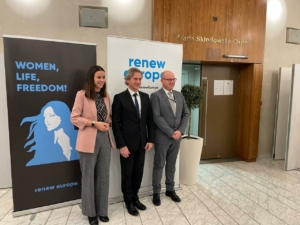
On Tuesday, 22 November 2022, MEP Irena Joveva addressed the European Parliament during its plenary session in Strasbourg on the European Union’s response to the worsening crackdown on protests in Iran. Borrowing the slogan “Women! Life! Freedom!” she expressed support for protesters and joined their struggle.

Joveva began her speech by saying that Iran could be an idyllic country were it not for the leadership under the government in office and were it not possible for the world to see everything happening in Iran. She referred to the constant repression of the people and the curtailment of fundamental human rights, including use of the death penalty,

It is precisely this kind of repression and the tragic fate of Mahsa Amini and many others, stressed Joveva, that have resulted in the very opposite effect this time, uniting Iranian women and men in a revolution. “They have brought together all classes, the old and the young, ethnic minorities, oil industry workers, top athletes”, said the MEP, recalling that a few days ago, Iran’s national football team boycotted the national anthem at the World Cup in Qatar.

“In doing so, they demonstrated the importance of this revolution on the world stage and manifestly joined the struggle, which has thus far generally been led by Iranian women. This struggle for women’s rights is receiving support from all corners of the world – including from this House. We have broken off relations with Iran, and rightly so.”

You can watch the MEP’s address on this link.

On Thursday, 24 November 2022, MEP Irena Joveva addressed the European Parliament plenary in Strasbourg on the legacy of the European Year of Youth 2022, stressing that we must act and work with and for young people.

MEP Joveva started her speech by saying,

The European Year of Youth is coming to an end. Or, if you prefer: the European Year of Youth is not over yet.”

That is why, in her view, it is difficult to assess its ultimate success and legacy at this point. Instead, she said, we could talk about specific ideas on how to improve the living conditions of young people, as there are many areas that need to be addressed.

Unfortunately, the European Union had not been able to do so this year, although many events had been organised. She supports such events and initiatives, but they alone are not enough and they cannot compensate for all past and future needs.

She concluded her address by saying:

Unfortunately, young people do not have an umbrella law, directive or act that is dedicated specifically to them. That is why we need to make sure that we always take their issues forward. I do. To work with and for young people is the least we owe them.”

You can watch the MEP’s address on this link.

About the European Year of Youth

Every year since 1983, the European Commission has chosen a theme on which to launch an awareness-raising campaign, reinforced by debate and dialogue within the European Union.

In her State of the Union address last year, Commission President Ursula von der Leyen announced the European Year of Youth, stressing how important young Europeans are to building a better future and that they must be placed at the centre of attention in the wake of the pandemic. The year has seen a number of events and one third of the participants in the Conference on the Future of Europe were young people aged 16–25. The closing inter-institutional conference, Claim the Future, co-organised by young people, is taking place in early December. The European Parliament stresses that the circumstances surrounding the European Year of Youth have not all been optimal (delays in funding, late Commission announcements, the increased cost of living).

In this year’s address, the Commission President declared that 2023 will be the European Year of Skills, with a focus on education and training.

During its plenary session in Strasbourg, MEP Irena Joveva addressed the European Parliament on the anti-European far right in the EU.

In her speech, she said there had been enough of turning a blind eye, as it is high time to free Europe from kleptocratic autocratic tendencies and to defend our values and the Union. She referred to a wide range of horrendous acts, such as the curtailment of human rights, attacks on free journalism and the LGBTQI+ community, disrespect for the rule of law, corrupt practices and the spread of intolerance – all of which are supported or even encouraged by Europe’s far-right.

Joveva stressed that all of the above points to a decline of democratic values and to the rise of illiberal tendencies. To illustrate this, she used the example of the far right in Slovenia engaging in a fictitious struggle against the long-defunct communism.

She concluded her speech by warning that the lack of action and solutions creates a breeding ground for the far right to continue to thrive and spread. In her closing remark, she said that the spread of the far right means a constant erosion of the foundations of the EU.

You can watch MEP Joveva’s speech here.

Today, MEP Irena Joveva addressed the plenary session of the European Parliament in Strasbourg on EU–Western Balkans relations in the light of the new enlargement package.

In her address, she reminded the European Union that it has been promising EU membership to the Western Balkan countries for years, but that the enlargement project is not being implemented in practice.

The MEP quoted part of the lyrics from a song by a well-known music group: “prazna obečanja su najbolja reklama” (empty promises are the best publicity) and explained that this is exactly how people from the Western Balkans feel, while in reality they are no less European than EU citizens.

“A promise is a promise and promises are to be kept.”

Joveva stressed that we need to be as strict on the rule of law, media freedom, human rights and other criteria in the Union as we demand from our neighbours. In her view, there are some Member States within the Union that are anything but paragons of virtue.

You can watch the full speech by the MEP by clicking here.