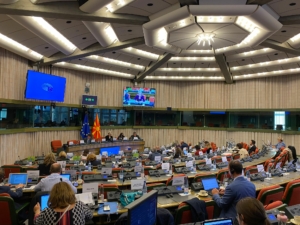
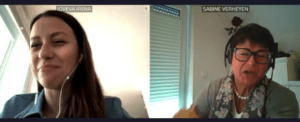
MEP Irena Joveva addressed the plenary session of the European Parliament in Strasbourg on the topic of the 2022 United Nations (UN) Climate Change Conference (also known as COP27) in Sharm El-Sheikh, Egypt.

She began her speech with the slogan ‘We Are Running Out of Time‘, under which the climate relay is currently running from Glasgow, Scotland (the host of last year’s COP26) to Sharm El-Sheikh, Egypt, the host of COP27 in November. The MEP added that tackling climate change requires all individuals acting at all levels.

In her speech, Joveva warned that despite the Paris Agreement, we are not close to meeting the commitments we made and that countries need to make new commitments to reduce emissions and stick to those already made. She also said that the sheer number of natural disasters already experienced should have woken us from our slumber.

Joveva ended her speech with the thought that we should have realised by now that we are running out of time.

You can watch MEP Joveva’s speech here.

In today’s plenary address on the topic of continued controls at the internal borders of the Schengen area, MEP Irena Joveva, in the light of the recent judgment of the Court of Justice of the European Union, stressed that the border controls in the Schengen area that are not based on legitimate reasons are unacceptable. They prevent the free movement of people and impede the commuting of cross-border workers. The free movement of people is a cornerstone of the European Union and, as such, of vital importance to Europeans. Preventing it can sow the seeds of mistrust between Member States and create discord among them. Since the reasons for the current internal border controls are far-fetched, the European Commission should present an official opinion, thereby protecting the Union’s interest, and the Member States should reach an agreement on the matter. That is possible. In this respect, borders exist only in the mind, she added.

You can watch the full speech by clicking here.

On Wednesday, 5 October 2022, MEP Irena Joveva attended a meeting between the European Parliament delegation and the North Macedonian Parliament (the Sobranie) and spoke about the state of the media and civil society in North Macedonia. First, she expressed her satisfaction at the unblocking of the accession negotiations and then, among other things, congratulated Macedonian civil society for acting as a guardian of society, protecting human rights and fighting for a better and fairer country.

During the two-day exchange of views between the two Parliaments, MEP Joveva, as Co-Chair, started her address in Macedonian and then focused on the state of the media and civil society in North Macedonia, which she follows closely. She praised the improvement in terms of media freedom in the country, which has progressed to a better level compared to other countries in the Western Balkans region. She added that the country still had some way to go in the area of fighting disinformation and ensuring transparency of state institutions.

Joveva also touched on the European Media Freedom Act. She said that the act was necessary to protect media freedom in the European Union, as political interference and government control should have no place in journalism. She stressed that media freedom is of the utmost importance for a functioning democracy.

To continue, Joveva welcomed that the accession negotiations were finally opened after they had been blocked for a long time by some EU Member States. In her speech, she also mentioned young people, who suffer the most from environmental, political and economic impacts. Other topics discussed by the participants included the energy crisis, the environment, the rule of law, good neighbourly relations, and cooperation in the region.

Referring to civil society organisations, she said: ‘They must be involved and consulted at all stages of decision-making, especially at local level in the policy-making phases.’

In conclusion, Joveva expressed her wish that the strategy for cooperation with North Macedonian civil society be implemented in a timely and transparent manner. She concluded her speech with the thought that the North Macedonian leaders should continue on the path of improvement strengthening an independent media, protecting journalists as well as the environment.

The delegation to the EU-North Macedonia Joint Parliamentary Committee (JPC), vice-chaired by MEP Joveva, met with members of the European Parliament and the Sobranie in the presence of representatives of the European Commission. The delegation meets in person twice a year to discuss the work of the two parliaments, their cooperation, joint activities and the approximation of North Macedonia to the European Union. The two-day exchange of views was followed by a vote on recommendations.

MEP Irena Joveva addressed the plenary session of the European Parliament in Strasbourg on the topic of the European Commission’s proposal for measures under the Rule of Law Conditionality Regulation in the case of Hungary.

In her address, she pointed out that the Commission had finally proposed freezing Hungary’s funds under the Rule of Law mechanism. She highlighted three key problems: that the move only affects a part of the funds, that money still flows steadily to Hungary from the current budget — despite corruption and the subversion of the rule of law, and that this is clearly a result of some sort of political deal. Along the same vein, she stressed that compromises with illiberal governments cannot be possible.

Her speech can be viewed here.

Today, during the plenary session in Strasbourg, MEP Irena Joveva addressed the European Parliament on the Health Union.

In her contribution, she pointed out that health is a sine qua non and that the quality of treatment and access to medicines should not depend on a person’s country of origin. She added that the mandate of the European Centre for Disease Prevention and Control (ECDC) should be strengthened and stressed the importance of successfully managing cross-border threats and public health risks.

Strengthening the mandate of the ECDC will enable the European Union to be better prepared and to coordinate its response to any future health crisis. Better cooperation between a wide range of authorities at all levels, the collection of timely and comparable data across the EU, and more accurate monitoring of national health systems will make it easier to fight disease outbreaks. The Health Union will ensure a stronger EU response to public health emergencies.

Here address can be viewed here.

Today, MEP Irena Joveva addressed the European Parliament during its plenary session in Strasbourg on the topic of the discrimination against the Slovenian language on digital platforms.

In her address, Joveva maintained that Members States and languages of the European Union are equal, and that the EU has a common market whose rules in the physical world must also apply in the digital one. She said that some multinationals operating in the European market are allowed to ignore this. She stressed that no discrimination is permissible and that everyone should have the right to choose, including, for example, to watch a series or a film subtitled or dubbed into their mother tongue.

She concluded her address by saying that no language is more important or less important than others, and that European multilingualism must be respected at all levels, including on all digital platforms. She urged all MEPs experiencing a similar situation to stand together.

Her address can be viewed here.

On Tuesday, 17 May 2022, MEP Irena Joveva spoke at the Committee on Culture and Education on the progress of the report on the impact of COVID-19 closures of educational, cultural, youth and sports activities on children and young people in the EU, to which she contributes as a rapporteur on behalf of the Renew Europe political group. She said, among other things, that children and young people need to be educated about mental health.

In her introduction, Joveva praised the current draft report, not least for including the importance of the educational, environmental and interpersonal aspects for the physical and psychological development of adolescents, which is then reflected throughout their lives, as well as the significance of sufficient financial support for educational institutions to adequately support pupils, students and teachers from a mental health perspective.

“It is also great to see the integration and mutual cooperation between the Union, Member States, local authorities and youth organisations to alleviate the impact of the epidemic.”

The MEP went on to point out that the draft report should also mention activities to supplement curricula with content that would teach children and young people about mental health. She also drew attention to the negative aspect of the use of digital education, which has also been evident among young people over the last two years. She explained that her main wish was to destigmatise mental health and, at the same time, to normalise help-seeking of all those in need of support. Joveva announced that she would also submit amendments to complement the report with an initiative to increase the number of appropriately trained staff to support young people in need.

“The report should also better address the problems of young artists who have abandoned their artistic projects, some even their artistic careers, because of the closure of institutions and the uncertainty created.”

On Friday, 13 May 2022, MEP Irena Joveva participated in the event “Mental health in Europe: where do we stand? – Youth in the Spotlight“, organised by the Renew Europe political group, where participants addressed the acute problem of mental distress among young people and presented some measures to reduce stigma around mental health. Among other things, the MEP stressed the need to normalise help-seeking in our society.

Mental illness, anxiety and distress have been on the rise for decades, both in Europe and around the world. Even before the COVID-19 epidemic, 84 million people had been diagnosed with a mental health problem in the EU alone (as many as one in six). According to the OECD, one in two people will experience a mental health problem in their lifetime and many of them will not receive the care they need. In her speech, Joveva expressed her concern about the growing negative trends and called for more decisive action in this field:

Although the epidemic has exacerbated the mental health situation, the problem has been present in our midst for decades. It continues precisely because of the perpetuation of stigma attached to mental health problems. We need to take the necessary measures to reduce the stigma around mental health and normalise help-seeking in our society.”

During the epidemic, the prevalence of mental health problems in people aged 15–24 doubled in most countries. The gravity of the situation is illustrated by the fact that suicide is the second leading cause of death among young people in Europe.
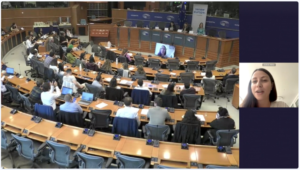
Joveva maintained that as long as mental health is stigmatised to such an extent, young people will not dare to seek help, which will inevitably lead to an even greater increase in mental distress. She believes that overcoming stigma requires education and providing people with the right information. This should start with mainstreaming mental health into school systems, while a frank conversation about mental health must continue with all members of our society (peers, parents, doctors, teachers, influencers, etc.).

Acting as rapporteur on behalf of Renew Europe, Joveva will contribute to a report on the impact of COVID-19 closures of educational, cultural, youth and sports activities on children and young people in the EU, where she says the main priority will be to focus on accessible, free and timely help for all young people with mental health problems, so that these can be coped with and overcome.
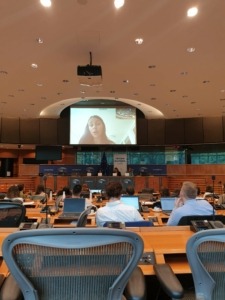
“The report will focus on the consequences of the epidemic and the lockdown that has caused younger generations to miss out on an important time of socialising, creating connections and spending time with their peers. We will look at the problems from the perspective that adolescence is a unique formative time in an individual’s life and that the world around us has a profound impact on our mental health.”

Joveva went on to explain that the mental health of children and adolescents is strongly influenced by the circumstances of their lives – their experiences with their parents and carers, their relationships with friends, and their opportunities to play, learn and grow.

She concluded by calling for an EU-wide plan to tackle mental health problems:“We need to facilitate dialogue and good cooperation between all Member States, local representatives, youth organisations, the education system and the private sector to create a comprehensive strategy that will deliver the desired results.”

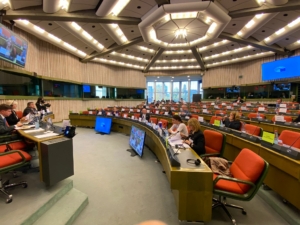
On Tuesday, 8 March 2022, MEPs discussed the situation in Bosnia and Herzegovina at a plenary session in Strasbourg. MEP Irena Joveva drew parallels between Dodik’s destruction of Bosnia and Herzegovina and Putin’s actions in Ukraine.

Joveva began by pointing out that, unfortunately, in the 21st century, autocrats and democracy destroyers still exist on European soil, threatening peace, human rights and fundamental freedoms:

“Thirty years after the war in Bosnia and Herzegovina, Milorad Dodik is destroying the country and its institutions. He denies genocide. As if what the people there have been through were not enough. Thirty years after the war in Bosnia and Herzegovina, a new war begins in Ukraine. Vladimir Putin is branded a criminal. And rightly so, because that is exactly what he is.”

Despite the EU’s immediate response to Putin’s actions, Joveva expressed concern that those of Dodik are noticed much less: “How can anyone fail to condemn his moves? Does his affiliation with some parties make him any less evil? The citizens of Bosnia and Herzegovina are no less deserving of a better life and leaders who care.” In her opinion, the citizens of BiH should be supported on their path to the European Union. “In the meantime, we must stand up – just as loudly –to all autocrats and criminals, because we have long seen too much hypocrisy of the European Union in this respect. Even within our own ranks. The methods are very similar. Unfortunately,” she concluded.

Joveva’s contribution to the plenary debate can be viewed on the link below:

Today, on 24 November 2021, MEPs discussed fundamental freedoms and the rule of law in Slovenia, in particular the complications around the appointment of European Delegated Prosecutors.  

If you criticise, attacks will follow. Either there is subordination or destruction. Either you support this government or you must leave. Either you belong to them or — basically —be careful.” These are the words MEP Irena Joveva used to open her debate on Slovenia. She underscored that deviations from democratic norms reach beyond national boundaries and become a problem for the Union, as was illustrated by the examples of Poland and Hungary.

In October, a delegation from the Committee on Civil Liberties, Justice and Home Affairs of the European Parliament examined the state of the rule of law and democracy in Slovenia, and in particular expressed concern about the non-appointment of European Delegated Prosecutors and the non-payment of services provided by the Slovenian Press Agency (STA). “The current Slovenian Government has recently yielded to pressure, mainly from the EU. They released STA funding, after almost a year of manipulation. They took note of the names for the European Delegated Prosecutors, after more than a year of legal farce.’ But the MEP warned that the financial difficulties of the STA were not resolved, as the contract for next year has not yet been concluded. And in the case of prosecutors, she believed that the decision on temporary nomination made a mockery of independent institutions.

Joveva notes that the Government’s relenting is only feigned and that pressure has been mounting elsewhere. “There are attempts to subordinate, silence or smear the prosecutors, the judiciary, the police, the media, NGOs, the independent, and regulatory agencies. In this, they use all means available.” In the communication of the ruling structures there lurks the desire to destroy institutions, conspiracy theories about communists are used as a cover for corruption and clientelism. “This is not about defending traditional values. It is about negating them,” said the MEP. She concluded her address by asking:

“Our institutions have managed to withstand so far on account of a rich democratic tradition and the integrity of individuals. But for how much longer? Where are strong, specific responses? When will you learn that the situation in one Member State affects the whole of the EU?”

The Renew Europe group also expressed growing concern about the political situation in Slovenia. After half a year of delay, the Slovenian Government has now nominated two national prosecutors to the European Public Prosecutor’s Office (EPPO), operational since 1 June 2021. Nevertheless, the group remains deeply concerned about the Government’s political interference in the process of appointing the prosecutors. Prime Minister Janez Janša dissolved the previous appointment. The group wrote that it could not tolerate a Member State intervening and undermining the function of an EU judicial body. For that reason, the group’s Members request answers from the Slovenian authorities.

Unfortunately, this is not the only example of worrying backsliding on the rule of law, as was also pointed out by Joveva:

“The Government’s aggressive attempts to seize control over independent media and the Prime Minister’s attacks on journalists and political opponents on social media shows that press freedom and fundamental rights are also at risk. The European Commission must act to immediately stop the attempts of Janez Janša’s Government to politicise key democratic institutions and challenge press freedom.”