
Let me first reassure those who are worried about my grammar: I didn’t make a typo. Equality is the most appropriate term in this case. And correct. If you take the time to read the post, you might be able to understand why.
We are not just talking about formal equality of rights. We are talking about equality in practice – about the actual possibility for every individual to live, work and make decisions without the limitations determined by gender.
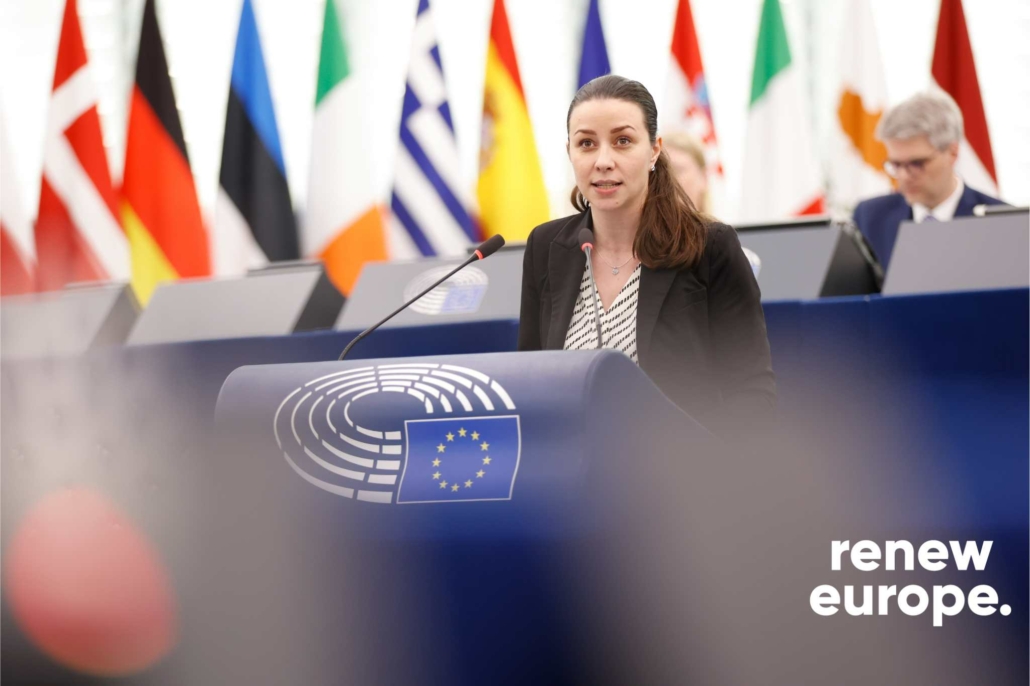
Both within the European Union and beyond, we often hear praise for progress in the field of gender equality. And it is true – steps have been made. But it is also true that we are still far from the goal. This very realization was one of the key guiding principles in the preparation of the European Parliament resolution on the pay and pension gap – adopted today. I participated in it as the main rapporteur, i.e. the Parliament’s negotiator for the text, demands and guidelines.
Because inequality, even if it is minor, is unfortunately not a thing of the past. It is a thing of the present.
But we have to start in the past.
One of the most famous slogans of the fight for workers’ rights is: “We do not want to be second-class workers”. I believe that each of us has heard it. And yes – I use the masculine form on purpose.
In 1968, this slogan was carried on banners by women in Great Britain. Female workers at the Ford factory, including Rose Boland, found that they were placed in a lower pay bracket than their male colleagues, despite doing equally demanding work.
They did the same work. They were less valued. And paid less.
So they went on strike. Their strike halted car production for weeks and dealt a serious blow to the British economy. And only then – when the system came to a standstill – were their demands heard.
It is no coincidence that the key role in the changes was played by politician Barbara Castle, who implemented the Equal Pay for Equal Work Act.
But this was not the first such case.
Have you heard of Gabrielle Defrenne? A Belgian flight attendant for Sabena Airlines, where women were paid less than men and had to leave their jobs at the age of 40.
She decided to sue, thus initiating one of the most important court cases in the history of the European Union.
The Court of Justice of the EU has ruled clearly: equal pay is not just a principle. It is a fundamental right. This decision has cemented equality at the very foundation of European law.
Now let’s skip forward almost 70 years. To today.
- 12% average gender pay gap
- 25% pension gap
- 28% of women work part-time due to caring responsibilities
- 74% of women perform care and household work on a daily basis
- 22% risk of poverty for women
- 35% of women experience psychological or sexual harassment
This is not a statistic. This is reality. A reality that exists despite legislation, despite rights, despite progress. And THAT is WHY we drafted a resolution on the pay and pension gap.
The report aims for equality in education, employment and the sharing of care work. It highlights women’s contribution to economic growth, the importance of intersectionality and the need for decisive action at EU and Member State level.
We placed special emphasis on work evaluation.
Today, sectors such as health, care, upbringing and education – sectors dominated by women – are systematically undervalued. And yet these very sectors are the foundation of social cohesion.
The pay gap is not a coincidence. It is a consequence. The consequence of horizontal segregation of the labor market, the undervaluation of feminized professions, and the unequal distribution of unpaid care work.
We therefore demand action: consistent implementation of the directives, a European supply strategy and a new European supply deal, backed by concrete investments.
We demand an action plan to close the gap. Guidelines for gender-neutral job evaluation. Implementation of the Istanbul Convention. And full implementation of the Pay Transparency Directive.
If these measures are implemented, we could also talk about real progress.
But unfortunately, the world is not perfect. This was also shown by the debate at the March plenary session, where some women took a stand against women’s rights – under the guise of “traditional values” that are being re-established.
In recent years, the “traditional” role of a woman who exclusively takes care of the household and raises children has begun to be romanticized through the influence of social media.
Of course, everyone has the right to choose and I support anyone who makes that choice of their own free will. However, on social media, these “traditional women”, who are supposedly unemployed, bring the majority of the income into the household, thereby ensuring financial independence and the ability to make a different decision at any time in their lives.
At the same time, they are bringing a dangerous movement into society, reducing the role of women to that of housewife, mother, and caregiver, without regard for financial independence. And that benefits no one. Not even the most “traditional” men.
The fact is: women make up half of the population. And we are the foundation of society – from the family to the economy and politics.
Today we stand on the shoulders of women like Rose Boland and Gabrielle Defrenne. And even more so on the shoulders of our mothers, who throughout their lives, in one way or another, faced or fought for their place in society. For equality.
Now it’s up to us to shape the world for future generations. At least half of them will be women. And I will never agree to the curtailment of rights or the perpetuation of inequality. Equality is not an ideology. It is the foundation of a just society. And equality does not happen by itself.
It is a decision. And every decision can build a society… or tear it down. My decisions will always be directed towards a society where equality is not a privilege. And where no one is “second-class”. That is the society I want.
For us. And for all who are yet to come.


Leave a Reply
Want to join the discussion?Feel free to contribute!