
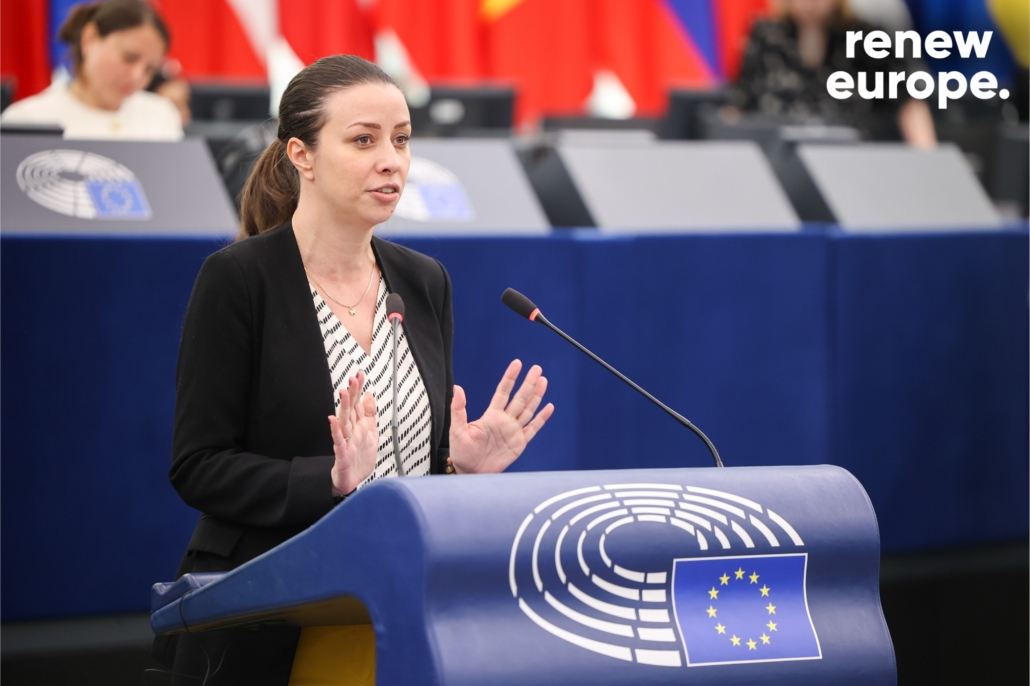
On Wednesday, 29 April 2026, MEP Irena Joveva took part in a plenary debate on the European Union’s strategy in response to the crisis in the Middle East and its consequences for energy prices and the availability of fertilisers. “It is time to dare to be decisive. To dare to think for ourselves. To stand up for international law, peace and the protection of people in the EU,” she said in her address.
“Many believe that politics and integrity do not go together. I believe that they do. If one dares,” Joveva began, emphasizing that it is precisely the lack of political courage and consistency of the highest representatives of the European Union that leads to its ineffective responses to global crises. “Our responses to the situation in the Middle East are too slow, predictable and, above all, ineffective and selective,” she added. According to her, this only reduces the influence of the Union as a global actor.
She was also critical of German Chancellor Friedrich Merz’s statements regarding US President Donald Trump’s policies, pointing out that such rhetoric normalizes a dangerous escalation of the situation:
“When Friedrich Merz talks about Donald Trump and his war in Iran in a way that normalizes a dangerous escalation, that’s not even realpolitik. That’s irresponsible.”
According to her, the European Union must not accept the logic of escalating the situation nor legitimize dangerous geopolitical moves, but must take a more active role in calming the conflict:
“We are not talking about a geopolitical game at a distance. This is a crisis. A crisis created by the genocidal Israeli prime minister and his “puppet”. The US and Israel are waging wars, and the citizens of the EU are bearing the consequences. Europeans are paying the bill. Bill after bill they are being punished for a war we did not start.”
She therefore stressed the importance of a unified, decisive and independent EU foreign policy, based on diplomacy and a unified foreign policy stance, reducing dependence on third actors and consistent respect for international law:
“It is time to dare to be decisive. To have integrity. To dare to think for ourselves. To stand up for international law, peace and the protection of people in the EU. All three are possible. I promise.”
Background:
The tense situation in the Middle East, where a fragile ceasefire between the US, Israel and Iran is in place, continues to have a significant impact on global oil and gas markets and is contributing to rising energy prices in Europe and around the world. Additional uncertainty is caused by restrictions on maritime traffic through the Strait of Hormuz, where disruptions to shipping for vessels bound for or from Iranian ports have led to supply chain disruptions and increased unpredictability of logistical flows. This is increasing pressure on the availability of key raw materials, also important for the European Union, in particular fertilisers, which are essential for agricultural production and the stability of food systems. As a result, the effects of geopolitical tensions are directly translated into higher living costs, weaker price competitiveness of the European economy and increased risks to food and energy security. At the same time, the current situation is revealing the Union’s structural vulnerabilities, in particular its dependence on external sources of energy and raw materials and its limited ability to respond quickly, in a coordinated and effective manner to complex global crises.


Leave a Reply
Want to join the discussion?Feel free to contribute!