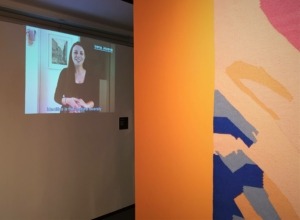
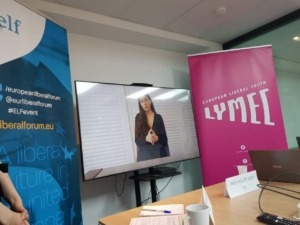
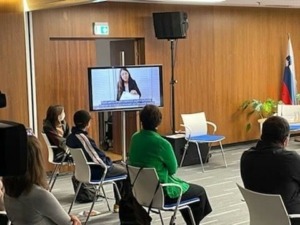
Digitalization and data are transforming the world. Modern technologies must benefit the patients most, and they must be the centre of this transformation, participants of the Days of eHealth conference remarked. MEP Irena Joveva also addressed the attendees of the conference.

Medicine offers patients more and more research, tests and examinations, which will be organized transparently with the help of modern technology and used effectively. The technology will also help us improve work processes in medicine and optimize inventory management, achieve optimization of waiting times and increase system transparency. These are, of course, our wishes, the reality is, however, not so ideal. To improve the health situation as quickly as possible, the Commission has declared the establishment of a European data space as one of the health sector priorities in the period from 2019 to 2025.

In her video speech, MEP Joveva emphasized that the common European health data space would promote better exchange and access to different types of health data, such as electronic health records, genomic data, patient registry data, etc., not only by supporting health protection, but also to support health research and health policy-making. She announced that several interested parties from the digital, health and private sector were working with the Commission on a new regulation: the regulation on the use of secondary health data. This will also include a number of important areas of health, such as the European Health Data Space, the Pharmaceutical Strategy for Europe, the European Medicines Agency Regulation until 2025 and the Europe’s Beating Cancer Plan.

You can watch the full speech below:


There were only two options. Either validate digital covid certificates… or allow Member States to (continue to) establish (each) their own restrictions separately and arbitrarily. I honestly believe, both options are bad but at the same time I am convinced that the second one is much worse and also more dangerous. That is the only reason why I voted in favour of introducing these certificates.

So… not because we will “return to normalcy” with these certificates, at least when traveling. I do not share this opinion. We will get back to “normalcy” when none of this is required anymore.

And even less because the certificate “will not be discriminating”. I do not share this opinion either. For the unvaccinated and those who have not recovered from the disease yet, the tests will not (necessarily) be free of charge, which is of course pure discrimination. However, do you know who is to blame for the fact that this condition – and another one that we unsuccessfully requested – is not in the regulation on the introduction of certificates? In this particular case, the European Parliament is not. It is the fault of the Member States (= governments).

It is therefore fair from me to explain in more detail why the introduction of certificates, in my view, is a lesser evil than the “solution” that would prevail otherwise.

In the European Parliament, in addition to free tests, we requested standardized and common criteria. We requested additional protection of personal data. We requested that the Member States should not add any (other) restrictions on the free movement of people at their national level. We requested a time limit of certificates to a maximum of one year. We requested a comprehensive report of the European Commission on the implementation of the system every three months.

What happened? We succeeded with some requirements (for example with common criteria, with protection, the time limit), but unfortunately not with the key ones, as the Council (= Member States) was not ready to give in to these negotiations: in free tests AT LEAST to obtain a certificate and in the PROHIBITION of imposing additional requirements or restrictions. Namely, the Council’s negotiators threatened the Parliament’s negotiators with the end of discussions and the consequent introduction of a separate system. Since this would have bypassed us and – I am sure – a much worse deal than the current one would be accepted, a compromise had to be reached. The negotiators have reached it by stating that testing must be “affordable”, by announcing that the European Commission will provide at least 100 million euros for it, and by an unfortunately non-binding assurance that countries should refrain from additional restrictions.

How the system will work in practice is currently not clear. I have quite a few doubts; simply because the situation is not the same across countries. Some, for example, already have testing free of charge, while others have higher prices for it than third parties, while fourth countries allow only PCR tests, and fifths also fast test. At this point, it should be emphasized that in the cases of the latter, these are not the wonderful and super useful tests that we have in Slovenia thanks to our ‘crypto boys’.

There is (still) a lot of illogicality, as well as ambiguity, but it is already clear at this point that the regulation does not take into account all the concerns. Although the majority of the responsibility lies with the Member States, I must clear up that in the European Parliament we are also partly responsible for the “result”, because we voted in favour of the regulation under an urgent procedure in March. I myself voted against at the time, as we took away the possibility of improving the regulation, we rejected a more thorough procedure that would allow an appropriate debate at parliamentary level. I wrote back then that these certificates would eventually become reality, and if we already knew they would, then we would at least form them in a way they would not deprive anybody’s rights.

I conclude that such and other comments will pour under this record. I have nothing against dignified expression of opinion but I have much against manipulation, misinformation, and ignorance, misuse of facts and distortion of the truth. That is why I will not engage in controversy and “persuading the convinced”. However, I will conclude exactly as I concluded in the note from March: The effectiveness of these certificates will depend on the confidence of citizens in it. The less there is trust, the less there will be a sense of responsibility and awareness, without which it simply will not go: no matter how we travel, in the end each of us will be the one to decide how to act. Wise or unwise. With or without certificates.

Irena Joveva


Exactly two years after the European elections … I did more than just grow a belly. 🙂 I am a member of four parliamentary committees and four delegations, I am a member of the working group on the reform of the functioning of the European Parliament, set up by President Sassoli. I was also a shadow rapporteur for more than 15 reports or opinions on reports, including one as rapporteur-general. I have (co-)signed a massive number of amendments that have improved the texts of the documents we have adopted in one way or another; we have written many letters, initiatives and appeals, answered many questions, comments and ideas. I listen to people, I keep my promises, I do not deviate from my principles, I have participated in many events, organized several round tables … I have a great team, without whom I can’t imagine working successfully at all. It is not scarce, whatever the epidemiological situation, but that is just the way it is. So, I sincerely hope that you see and feel our efforts to justify your trust and your support.

But as the lady and I are already close to the finish line, I would like to take this opportunity to let you know that I will be a little less active on social media in the coming weeks. That doesn’t mean that work will suffer — just because of the great team already mentioned — but it also doesn’t mean that I’ll go on maternity leave for a year and be gone. I will keep you up to date on what is happening, on everything important, especially on all significant substantive developments, as much as I can, and today I will toast (with a non-alcoholic beer!) to three more years of this mandate. I have even more willpower (also because of this ‘pumpkin’ I am carrying), more plans, more goals, more reasons — because of you. Thank you!

Irena Joveva

Photo: Marko Delbello Ocepek

On Monday, May 24, a group of MEPs, including Irena Joveva, European Council President Charles Michel, European Commission President Ursula Von der Leyen, the High Representative of the Union for Foreign Affairs and Security Policy and European Commission Vice-President Josep Borrell and European Commissioner for Transport Adina Valean sent a letter on the situation in Belarus. The signatories call for immediate action against the illegitimate regime of Alexander Lukashenko and the hijacking of the Ryanair FR4978, as well as the kidnapping and arrest of Belarusian journalist Roman Protasevich and his partner Sofia Sapego.

The members of the Media Working Group in the European Parliament are pointing out in the letter that this is an act that can be qualified as terrorism under the auspices of the state. They strongly condemn Protasevich and his partner’s abduction and call on the addressees to their immediate release. In addition to their forcible arrest aboard an EU-registered aeroplane flying between two European Union capitals, the Lukashenko regime also illegally detained passengers and crew of the Ryanair FR4978 aeroplane. Furthermore, the Belarusian presidential press service has confirmed that Lukashenko has personally demanded the use of a Belarusian MiG-29 military fighter jet to escort an EU-registered passenger plane to the Minsk airport forcibly. This measure was carried out due to a false security request and has endangered the lives of all who were on board of the aircraft. The use of such dangerous intimidation techniques, the temporary detention of passengers and crewmembers on Belarusian territory, and the violent kidnapping and arrest of Protasevich and his partner are unacceptable, which is why the signatories call for action against those accountable for these acts.

The actions of the Belarusian regime are unprecedented and unendurable, as the Belarusian airspace can no longer be considered safe for European passenger aircraft. Therefore, the signatories call for the immediate cessation of flights over the Belarusian airspace, the termination of all air connections between the EU and Belarus, the immediate closure of EU airspace for all aircraft registered in Belarus, and the International Civil Aviation Organization to revoke Belarus’ membership. In addition, they call for an investigation into violations of international aviation rules and this outrageous piracy act.

The signatories believe that this act of state-sponsored terrorism was a brutal attack on the EU and has endangered the security of the EU and passengers as well as the crewmembers on an EU-registered passenger plane. This is illegal and outrageous piracy and kidnapping, which must be addressed with a strong and united European response in the form of extended sanctions against Alexander Lukashenko personally, as well as against all those accountable for these acts.

You can read the original letter (in English) at this LINK.


Today, on May 25, 2021, MEP Irena Joveva hosted a round table on the position of young people in society, social challenges and the situation after the corona crisis. Participants at the round table were: Ronja Gorenc Didanovič — student and vice-president of the European Youth Parliament Slovenia; Tea Jarc — president of the “Mladi plus” trade union; Tadej Jezernik — student and head of the tender preparation at the organization of Slovenian student clubs ŠKIS; Nik Prebil — MP of the LMŠ party and Vice-Chairman of the Committee of the European Union for Foreign Affairs; Marjan Šarec — MP and the leader of the LMŠ party. Together they were seeking for answers on how to solve the social situation of young people in Slovenia and how to approach young people at the European level and explain to them how the EU can help. MEP Renew Europe and a member of the Executive Board of the Conference on the Future of Europe, Guy Verhofstadt also contributed to the debate with a video.

MEP Irena Joveva was concerned by the fact that 75-and-more-years-olds explain their views on the future. With all due respect to the elderly, in this case, we must first look at the situation of young people today and then look ahead, together: “The recently launched Conference on the Future of Europe project is a great opportunity to review the situation, find solutions and, of course, implement them.” Guy Verhofstadt also presented the functioning and motives of the Conference on the Future of Europe, pointing out that the world is changing very fast. These changes of the coming decades are leading to an entirely new society of Europe: “Europe will not survive this century if it does not change and reform.” Marjan Šarec said that the participation of young people in politics was important, as was the awareness that they can only change something with politics: “Political parties must put young people on eligible places of the candidate lists and offer them the opportunity to prove themselves. If they do not get that opportunity, they cannot show everything they are capable of. Questions about young people can only be addressed successfully in a party that has an overview of all topics. One issue parties are not successful in this, that is why each party must have young people in its ranks.”

Ronja Gorenc Didanovič pointed out that the knowledge of the functioning of Europe and institutions among young people is still relatively poor, which is also due to the feeling of young people’s distancing from decision-making processes. “It all starts in the education system – if you educate young people from an early age about the importance of politics, they are more receptive to its messages. On the contrary, they equate it with partisanship, power struggles and disputes, instead of thinking of it as a broader system and something that affects our everyday lives.” It bothers her that the young people are only being asked about youth issues, instead of being actively included as participles in decision-making processes. Meanwhile, Tea Jarc pointed out that young people are also socially active and responsible in non-political ways; therefore, civil society should be included in politics: “We have an above-average share of young people who are volunteers and want to help in this way. They are more open to diversity, acceptance and solidarity. Sometimes young people also fight in the streets and protests responding to what the country is changing into.” She is concerned that young people are always the losers of crises, as irregular forms of employment make them the first to lose their jobs and consequently, they have problems with housing or creating a family: “Employment of young people for an indefinite period, on-the-job training, mentoring programs and confidence that young people are not an expense, but an investment should be encouraged.” Hence, the treasury is being filled, added value created, recovery and economic growth, Tea Jarc added.

Tadej Jezernik sees good and accessible opportunities in European programs and policies for young people, but they need to be presented in a better way and moved closer to them. The housing problem is a huge issue: “We have many empty flats and at the same time flats with rents rising to the sky, completely inaccessible to young people, as it all starts with how much money they can spend on housing. At the time of the pandemic, we were oppressed and left at the mercy of financial government measures.” Gorenc Didanovič also pointed out the fact that many young people, who lived an independent life before the pandemic, were forced to return to their rooms at their parents’ house. She describes the reaction of the current government to the plight of young people as offensive.

As a representative of the younger generation of politicians, Nik Prebil pointed out the fact that not all politicians are the same, which can be best demonstrated by work: “Decision-makers have to prepare appropriate policies that will be effective in the long term. Slovenia needs quality jobs with high added value. We will soon go through a green breakthrough and digital transformation, and some jobs will be lost or need to be transformed.” He said it was good for young people to study and gain experience abroad, but politics must create interesting and attractive conditions to make them come back.

The interlocutors agreed that the key problem is the underestimating and patronizing attitude towards young people and insincere communication. MEP Joveva concluded the event by saying that the principle “nothing about young people without young people” should be upheld.


On Friday, May 21, the students of the Student Community of Ljubljana organized an online conversation “Students of the European Union”. Besides the MEP Irena Joveva, Nastja Orel, a member of the Committee of the European Youth Parliament Slovenia, and Petar Mrdović, a youth delegate of the Republic of Slovenia to the Council of Europe, also took part in the discussion. They spoke about the European Union, internship opportunities and awareness-raising among young people.

In the beginning, they touched on the most current issues – the forthcoming Slovenian Presidency of the Council of the European Union. MEP Joveva explained to the students what the presidency of the EU Council means: “The six-month presidency of the country holding the presidency brings some advantages and opportunities but it also a kind of privileged access to information. Although the country must, of course, be neutral and impartial in negotiations, it can nevertheless use this presidency to highlight certain priorities. During this time, Slovenia will become a center where meetings at all levels will take place.” She expressed the expectation that the current Slovenian government would not use the presidency to pursue ideological or party interests. She wishes that this presidency is carried out successfully by Slovenia, so that after it “we won’t be shaking our heads even more as we are now”.

Ms. Joveva said that we see the advantages of membership in the Union if we compare Slovenia with, for example, any country in the Western Balkans: “Leaving aside the economic benefits, we have better environmental and food standards because we are part of the Union. Free movement of labor, goods, services, capital. Greater social protection, protection of human rights and protection of minorities and vulnerable groups. If we look from a completely practical point of view, there is also the use of mobile devices and mobile data. Using them in another member state is completely self-evident to us and we do not care if we travel because the price is the same everywhere as it is at home.”

Joveva also pointed out that the peers of young people in the Western Balkans have a more difficult access to youth programs such as Erasmus+ and the European Solidarity Unit as well as to internships in European bodies. “There is really tremendous potential for various internships but at the same time the competition is great. Young people from the EU, as well as more widely, are applying for internships in all EU institutions and agencies. All internships are published on the epso.europa.eu portal. They can be shorter or longer, lasting a maximum of six months, but unfortunately at the moment, due to epidemiological measures, young people do not get a completely authentic experience.”

The MEP advised young people to take advantage of these opportunities and to take part in Erasmus+ exchanges, as they would gain different knowledge and insights into working at the European level. Ms. Joveva herself has open places for internships but unfortunately, due to the current situation, only one intern has been working in her office for now, and even that in epidemic-appropriate conditions, when the European Parliament was almost a ghost town. “As soon as the normal way of working is established, we will continue with the internship and anyone will be able to apply. Preference will be given to young people who have not had a similar experience yet.”

Next, there was a discussion of raising young people’s awareness of the EU and the work of its bodies. “Those of you who have organized this conversation and those who are listening are involved and are already aware of the importance of being informed. We need to address and include those who are not here today.” Joveva sees the best way to raise awareness through social media, as young people use these platforms on a daily basis. She also believes that the manner of communication is crucial. “Topics should be explained in the simplest possible way. If I were to write, “I was at a trialogue on ESC today” under a post, I would not say much. It is necessary to simply clarify what a trialogue (negotiations) is and what the European Solidarity Unit (ESC) is. Even through projects such as the MEP’s diary, I try to explain European issues in a simple way, in understandable language. I insist that if you can not tell the essence of some of the most complex topics in one minute or one page, you have not prepared yourself enough or you are not familiar with it well enough.” The MEP confided to the students that she would rather work on her own posts on social networks, and that these were in fact her texts, even though she did not publish them every day. She finds it crucial that politicians are honest and not patronising in raising awareness.

In the end, Joveva gave the students a sincere piece of advice: to be curious. “Ask questions and stay active. Raise your awareness by critically reading various portals and use sound consideration. If something you read sounds too good or too simple to be realistic, then it is definitely fake news. The future is in your hands!”

 “Really, you’re a journalist? That rules! And where?”

“At STA.”

“…”

“The Slovenian Press Agency.”

“Oh … OK.”

This is how many conversations took place when – a decade and a few months ago, on the year of its 20th anniversary (which is also explained in the photo below) – I started my first ‘serious’ job. This does not mean that I am ashamed of the previous ones or that they are worth anything less, but they were typical student jobs, from various promotions of different products in shopping malls to restaurant work. Honestly, this one also started when I was still a student. Nonetheless, it was different. It was special.

Many people did not know and even still do not know about the Slovenian Press Agency. One does not know everything that STA is and everything it gives, that is why the “oh, OK” up there. Because many people do not pay attention when they open a web portal and do not notice that STA is (co)signed under a huge number of articles. Because many people do not know that STA is the one with the collected daily forecasts of events in the country and around the world, which comes handy to any other media as well as to the interested public. Because many people are not aware that STA is a pillar of Slovenia journalism. The foundation of everything.

If STA falls, the key information source in the country falls. All other media fall (by that I mean the media in the true sense of the word). Democracy falls. Freedom falls.

Yes, I was a journalist at STA. And it really did “rule”. At STA I have learned speed but accuracy. At STA I have learned correctness but being no less critical. At STA I have learned comprehensible reporting on complex content. I have said many times that I could not have wished for a better springboard for everything else that followed. My former colleagues are professionals in the true sense of the word.

Not only do they not deserve what is happening to them under the current government, the society as a whole does not deserve it. STA is not “only” a public media service. STA is a symbol of Slovenian independence, which – like our country – is on the threshold of its 30th years of existence. With the difference, that it is not certain how and if they will experience it at all.

Because we have come to the point where the government does not want to pay its funds for public service in violation of the law! When they deliberately, shamelessly procrastinate with cynical manoeuvres such as asking the European Commission if these funds can be paid off at all. Of course, it was clear in advance (to them as well) that the answer from Brussels would be affirmative, but even that did not stop the government’s manipulations and lies, and above all the continuation of the STA’s financial exhaustion. Again: an illegal one.

We have reached the point where one irrevocably resigned minister is primitively mocking the fact that citizens are now starting to raise funds for the Slovenian Press Agency with the help of the Slovene Association of Journalists.

We have come to the point where, unfortunately, I can write without a hint of bad conscience that this government is making fun of everything and everyone. When experts are lecturing about the media (perhaps it will be more understandable if I translate: salting the mind) for the one and only truth that must be completely adapted to the boss. However, the bigger problem than this boss are those who are present and are quiet. An even bigger problem, however, are those who are ignorant.

We have reached the peak of not only a war with the media but specifically a war to control them. Today is World Press Freedom Day, and if ever, it is sadly more than clear today that media freedom is also being threatened in democratic societies. Yes, also in Slovenia. A climate of hatred towards journalists is being created systematically, attempts are being made to subdue and/or suppress all those who do not like the ruling party, fear and the feeling of helplessness of people are exploited systematically, and attention is being distracted systematically from real issues. A goal-driven process is only escalating. All of this is packed in the narrative that they are talking about media pluralism, while not lagging behind fictions like this that critical media is associated with the ghosts of the past. It is not a right-left political battle, as they are trying to portray it, but on the one hand a model of a democratic liberal society with critical independent media and on the other a model of authoritarian state abduction by the party and complete subordination of the media space.

Certain European legislation does exist, such as the Audiovisual Media Services and Copyright Directives. The problem is that they are still not implemented in all national legislations. There are also acts on digital services and the digital market that will set clear rules for moderating content on online platforms. Separately, the European Commission has several tools to put pressure on member states and these often collide with ‘real-policy’ in the Council, and often can not be applied to the media sector. This is exactly what could be changed with the new European legislation on media freedom. In the meantime …

The Slovenian Press Agency must continue to exist, while it must become clear to everyone that we will never be able to eradicate manipulations and lies. However, we can no longer give them space, we do not believe them and we no longer give them the opportunity to come to power. Never again.

Public media are the foundation of any democratic society. This role is more than justified by the STA, and this record was created mainly because the work and people at STA do not deserve an “oh, OK” but one big, the biggest “that rules!”

Irena Joveva

Photo: MMC RTV SLO/Miloš Ojdanić

On Thursday, April 29, 2021, MEP Irena Joveva was the keynote speaker at the closing session of the European Youth Seminar of the European Parliament on the topic of the European Union’s role in supporting press freedom and media literacy and the EU’s role in curbing fake and fabricated news and disinformation. Joveva spoke to the young people from her experience as a former journalist and as an MEP.

An international group of students from Luxembourg, Poland and Lithuania attended the seminar. They were particularly interested in the role of the European Union in the fight against disinformation. Within the team virtual workshops in the morning, they were developing proposals, ideas and solutions that could improve the European media and social landscape in this respect, and then they presented them to the MEP and discussed them together. In her introduction, Joveva shared her personal story about the discrediting and fabricated news that were spread by her political opponents when she entered politics. “Nevertheless, it is important to remain authentic – not being able to bluff, being polite but also being direct and straightforward are my greatest qualities,” she explained. “But fake news can do a lot of damage. Even if you identify them and try to correct them with an official statement, they have spread too widely until then,” she said, explaining their ubiquity with the feather pillow phenomenon. Once you shake the feathers out, all can never be found and put away again. She advised young people to consistently report fake news and disinformation, as this is the only way to limit its spread.

During the workshops, all three working groups came to similar conclusions. Young people identified journalists as the most important guardians of relevant and truthful news. This is why they perceived a need for greater protection, including police protection in the event of threats. Immunity has even been considered to protect journalists from legal proceedings brought primarily to silence them or prevent them from publishing revelations of their investigative work. We would also give journalists free access to quality lawyers. They believe that online portals should suspend access to influencers who spread lies or disinformation, and they also attach great importance to the importance of education on safe internet use and how to identify fake news. They also saw a solution in online ‘check points’ where EU citizens could check the credibility of news. They also recognised the public and state media as the absolute bearers of media freedom.

Joveva agreed with their findings and added: “We have to realise that the problem is not only in all of the above, but also in politics itself, or the way politicians communicate with people, which is also the case with some European politicians. They are not honest with the people, and they do not believe and trust them. That is why instead of trusting politicians, people go online or to social media and follow people and news that are obviously fake but easier to understand. This is particularly evident now, in the time of pandemic. The journalists did their job correctly, but since politicians did not provide all and above all concrete and honest information, people, each in their own way, looked for it on the internet.” She also stressed the importance of better working conditions for journalists who are often economically very vulnerable due to precarious employment. For this reason, they often prefer not to expose themselves by reporting on events or people that could threaten their existence.

She added that she was pleased that Commissioner Thierry Breton had recently presented the possibility of drafting European legislation on media freedom to the European Parliament. While the powers of the European Parliament and the Commission are limited, every effort must be made to ensure that the public service media remain at the service of citizens and not political parties. At the end of the meeting, Joveva thanked the young people for their participation and their great ideas. She advised them to remain active and involved in all processes and to keep in touch with their political representatives and regularly provide them with their opinions, comments, ideas and criticism.


On Wednesday, 7 April 2021, MEP Irena Joveva participated in the online debate “The Pandemic, Youth, and Europe: how to prevent a lost generation?” organized by the European Parliamentary Association. In their discussion, young Europeans focused on preventing long-term mass youth unemployment and filling the skills gap that will result from the disruption of the traditional learning process.

The pandemic is reducing young people’s opportunities for education and employment. Increasingly, we hear that the ‘lock down’ generation is the lost generation. MEP Joveva agreed with the young people that it is really hard to be 20 years old at this time. “It must be a challenge to be isolated with no real social contact and getting their education through distance learning.” She began by pointing out that education is a Member State competence, meaning that countries have faced the challenges of the pandemic differently. But this does not mean that nothing is being done at the European level.

At the beginning of the epidemic, in the so-called first wave, when we didn’t know much about the virus, the only right thing to do was to close educational institutions. No one knew how long it would last, for how long the distance learning would be needed, or what the effects of this kind of teaching would be. Today we witness that European education systems have many shortcomings.” Joveva agreed that the pandemic has also led to a lack of social skills development and increased psychological consequences and inequalities. “Since before the pandemic we in Parliament have been working on promoting IT skills, STEM education (science, technology, engineering, and maths), volunteering, internships, exchange programmes … Erasmus+ and the European Solidarity Corps are excellent examples of how we are trying to bridge the gap between traditional schooling by teaching international competences, encouraging practical work, and opening up new horizons.

Joveva also emphasized that digital education is crucial as it represents an investment in the future and the development of individuals and society. In October, the Commission, which has been working on education reform and Union-level guidelines since before the pandemic, presented its Digital Education Action Plan. It is in the common interest of all EU Member States to fully exploit the potential of education as a driving force for job creation, economic growth and the transition to the digital economy, and for greater social cohesion, especially in the light of the ongoing crisis we are facing momentarily.

Participants agreed that during the pandemic we all became (even more) aware of the importance of volunteering. Joveva, who was shadow rapporteur for the European Solidarity Corps, said that Parliament was working to further improve volunteering opportunities. The new European Solidarity Corps programme will be more accessible, more inclusive, and will provide more safety and security for participants, additionally, online volunteering was also highlighted.

National agencies can invoke force majeure clauses. This will allow them to assess the possibility of accepting additional costs up to the maximum grant amount. It also allows them to postpone planned activities for up to 12 months per project. The Commission has also secured €100 million for the Digital Education Call for Schools, which will support projects in school education, vocational education, and higher education. The aim of this call will be to improve online, distance, and blended learning – including support for teachers and tutors.

Despite the complexity of the topics discussed, the young people concluded the debate with optimism, and were especially pleased to have had the opportunity to share their experiences and reflections with the two MEPs. In addition to Joveva the young MEP Alexander Bernhuber (EPP) from Austria also took part in the discussion.

The 18th meeting of the EU-North Macedonia Inter-Parliamentary Committee took place on Thursday, 25th of March, 2021, where MEPs and their colleagues from Sobranie discussed the state of play of EU-North Macedonia relations, focusing on the implementation of the acquis in the accession negotiations.

MEP Irena Joveva, who is also the first vice-chair of the committee for the European Parliament, notes that North Macedonia is in a time of emergency, both because of the pandemic and because of Bulgaria’s veto. “I will not talk much about the reforms we all know that need to be implemented – especially in relation to the rule of law and efforts to fight corruption. The reforms in North Macedonia are about improving the lives of citizens, not the European Union. It is the latter that must keep its promises. The accession process should not be misused to solve bilateral issues,” she said, adding that it is citizens who suffer the most from open bilateral problems, unfulfilled promises, and endless talks without solutions. It saddens her to see that despite years of effort and endeavour that North Macedonia has put into the process, and its visible progress, the road to the Union is still long. She concluded her speech by encouraging them to overcome this last obstacle by working together with courage.

Deputy Prime Minister and Minister for European Affairs, Nikola Dimitrov, began by welcoming the adoption of the resolution on North Macedonia in the European Parliament but expressed regret that the amendments condemning Bulgaria’s provocative actions against North Macedonia had not been adopted, a view shared by MEP Joveva. “Although some challenges have emerged, such as the pandemic and relations with Bulgaria, North Macedonia will not stop. In the coming months, it will be crucial for the country to continue with reforms, including the fight against corruption, organised crime, and ensuring freedom of speech. We will continue to engage in a constructive dialogue on bilateral issues with Bulgaria,” Dimitrov assured MEPs.

Genoveva Ruiz Calavera, Director in charge of the Western Balkans at the European Commission, and Marko Makovec, a representative of the European External Action Service, both also noted that the country had made progress and demonstrated a commitment to the path towards the Union. “North Macedonia went through a long process of building compromises from the official change of its name to joining NATO,” Ms. Ruiz Calavera added.