Today, on 28 February 2022, the Savus newspaper published an interview with MEP Irena Joveva and Marjan Šarec, the LMŠ President. You can read it in full below:
Joveva, who was elected from the LMŠ party list, comes from Jesenice. She lives and breathes the values such as honesty, work and solidarity. In Brussels, she is actively co-shaping policies that enable development and a fair transition for regions such as Zasavje, and she is energetically addressing the issues that matter to young people. In the former Yugoslavia, the Jesenice ironworks was one of the important industrial centres. You could say that you come from a place that resembles Zasavje as it used to be.
My father worked in the Acroni steel mill for 40 years, my mother was a cleaner. I am proud of the fact that I come from a working-class family. In a difficult economic situation, my parents searched for a new opportunity in a new environment, starting practically from scratch. They could not spoil me as a child as they simply didn’t have the means for that, but they nevertheless gave me everything. I believe that a working-class background is a good foundation for a healthy attitude to life, because it helps you keep your feet on the ground, in touch with people’s real problems… And yes, it is probably very similar in Zasavje.
Is work still a value?
You know, due to new forms of work and turbulent labour market conditions, it may sometimes seem it is not, but it is. Work most certainly still is a value. At the European level, we have been working very hard over the last two years to ensure that every EU citizen can get a quality job with adequate pay. But providing adequate pay is also linked to providing appropriate education. The resolutions that we are adopting address the potential of the education system in the sense that that the goal of education will not be to get a degree just for the sake of it, but that there will be an increasing focus on vocational and professional education and lifelong learning. Work is and always will be a value. Above all, every type of work deserves respect, and workers should be appreciated and properly rewarded for it.
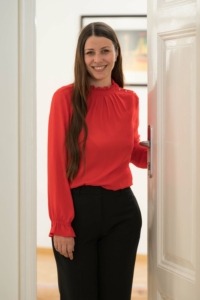 Innovative stories are being created in Zasavje, too. Here you will find high-tech companies that are becoming important players on the global market, but they are always faced with staffing challenges. This is also because the road to Zasavje, which is in the heart of Slovenia, seems like a road to the end of the world. Everything simply cannot be done remotely.
We may be aiming for a digital society, but that does not mean that basic infrastructure can be neglected on that account. People need high-speed broadband internet, but they need good public transport connections just as much and, ultimately, modern road connections, including the never-realised tunnel link to the Štajerska motorway. I am convinced that, if this link existed, investors would be keen to exploit the advantages of Zasavje and bring their companies to the region. In this respect, the current Slovenian Government should, first and foremost, make use of the European funds available, primarily from the Just Transition Fund, but also from complementary sources at the national level.
Zasavje very much counts on grants available to coal regions in transition …
… And these funds are not scarce. A total of EUR 538 million will be allocated to Slovenia. The inclusion of your region, alongside the Savinjska region, was one of the greatest achievements of Marjan Šarec’s government. It is true that the scope of programmes for drawing on these funds is limited by the regulation, but there are still many opportunities for using them in a productive manner. At the same time, this allows for the setting of a long-term strategy for the region’s development in terms of green transformation, which must also be based on economic development. To that end, it is essential to have a good vision of the kind of Zasavje you are aiming to achieve. If, after the mining activity was discontinued, the region was left with a surplus workforce and the economy developed rather haphazardly, Zasavje now has an opportunity and a chance to chart a clear development path for itself. Should it strengthen its crafts and business sectors? Attract investors, achieve a breakthrough with high-tech companies? How should it attract the workforce it needs? Does it provide for the necessary housing, schools, kindergartens, what quality of life does it offer? What do the people living here want? Is the local administration able to come up with good projects for the absorption of the development funds that will actually contribute to the region’s growth? All these are tasks that you, the people of Zasavje, have to set for yourselves, and this is what will determine the success of the development strategies and the future of Zasavje. But there is no doubt that the EU will provide substantial help in making these plans a reality.
The future will be highly electrified, and we still haven’t decided which sources we intend to get our electricity from. In Hrastnik, the largest solar power plant in Slovenia has already been built on degraded mining land, and another one is planned.
We can no longer turn a blind eye to the energy crisis. We are in the middle of it. As our electricity consumption grows, we will have to decide which sources will be used for its production. My compliments to the region and the municipality of Hrastnik. Zasavje used to be an energy region once, now it can become a good practice example of the transition to a low-carbon society. There is a political consensus in Slovenia that, in addition to the construction of a new nuclear power plant unit, we urgently need significantly bigger investment in renewable energy sources in order to secure a stable source of energy. In my view, solar energy makes by far the most sense for Slovenia. In addition, the price of solar panels is declining sharply and it is already cheaper than energy produced from other sources. In parallel, this will reduce our need to import raw materials, such as gas. Furthermore, from the point of view of the European legislation, the current investments in solar energy will quickly be recouped because of the polluter pays principle, which is reflected, for example, in the price of emission allowances.
How do you see Slovenia in 20 years? What happened to the dream of becoming the new Switzerland and could we become the Silicon Valley of Europe?
Above all, I see Slovenia as a country where, I hope, the new generation of politicians will be better than – pardon the expression – the current old set. I’m not referring to the new generation that learns its ways primarily from the current power structures, but the one that fights against them. I’m referring to the generation that is aware that it must decide its own future. Young people are becoming more and more politically active and they really can change many things for the better, but they need to be given the chance and taken seriously, because they are not trying to rub anyone up the wrong way, they are fighting for the right cause. After all, they are also fighting for my daughter, who, of course, is not yet able to do so herself in this way, and I hope that – precisely because of the young people who are active now – in 20 years’ time she will not even have to. We have a wonderful country, let it become development-oriented country, a country that is breaking new ground, and, above all, let those at the top take care of their citizens. That is what I want today, tomorrow and in 20 years’ time.
Yet young people are leaving in large numbers. Zasavje, in particular, has a very poor demographic profile.
Youth emigration is a problem faced by many EU countries. It reflects the ambition and desire of young people to build a quality life for themselves. Most often, they leave during or immediately after their studies, when they go out into the world to gain new knowledge and experience. If they return, this is beneficial to their home country, but this depends on the country’s attractiveness and the adequacy of the living conditions. It depends, in particular, on whether the country is successful in tackling housing issues and astronomical rents, in providing adequate education, offering quality and flexible jobs, creating the right conditions for young families, etc. The current government is doing a poor job in youth policy as a whole, which was even more pronounced during the pandemic. This is unacceptable. Creating good conditions for young people and investing in them is an investment in a positive future.
We find ourselves in a super-election year. How does Brussels view political developments in Slovenia?
Concerns did not vanish with the end of Slovenia’s Presidency of the Council of the EU. We are no longer in the forefront to the same extent, but this does not mean that Brussels is unaware of the situation in our country. Everyone hopes for a change to happen and is counting on it happening in April. But the change cannot happen in Brussels; we have to take care of it at home. The claim that all politicians are equally bad, that we are all the same, is not true. Nor is it true that elections do not change anything. You know what really cannot bring about any change? Abstaining from elections. That is why I really want to see a high voter turnout and people realising how important it is for them to go out and vote and to use the power they have. Because they really can demonstrate power.
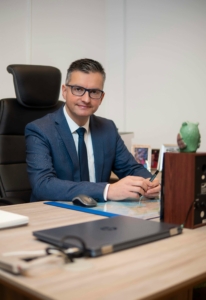 Marjan Šarec: “You can be an example to us all”
The people of Zasavje are considered to be upright, determined and persistent. It is the tradition of mining that has shaped you this way. Now, you are becoming a globally competitive knowledge hub, a crossroads for new, innovative and clean technologies that not only open up new jobs with higher value added, but are also attractive to young people. This is a great success that cannot be ignored. At the same time, you have driven a major polluter out of your valley. You can be an example to us all.
Last November, when I visited Zasavje with Deputy Rudi Medved, I said that all potentials for the development of your region should be exploited, and that it is essential that all municipalities work together, overcoming the silo mentality, to make more efficient use of the European funds available. The establishment of provinces, which the LMŠ supports, would certainly help to achieve this.
Our Party’s guiding principle is that we build on reality, not illusions. We don’t make big promises, but our promises are realistic, which we try to deliver on. The slogan “Normalisation. Solutions. Development.” confirms this. We have shown – both when in power and opposition – that “we walk the talk” and that the main motives of our political engagement are to co-create a different and better future and to stand up for a fair and better regulated country, our homeland.
 In response to the question about the state of the media in Slovenia, Joveva expressed concern that the situation in this area had been poor for a long time, but with the current government coming to power it had deteriorated drastically. Independent media are thus subject to smear campaigns, attacks and pressure. To counter that, the EU is drafting the European Media Freedom Act, which will equip MEPs and the European Commission with stronger tools to act in this area.
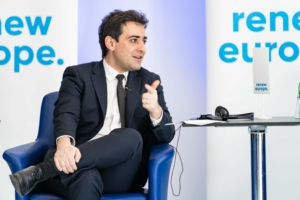 Green policy and sustainable solutions are also among Renew Europe’s main priorities. Séjourné said they wanted to achieve radical decarbonisation and strike the right balance while at the same time adopting the right measures to help the economy. For Grošelj, the biggest challenge in terms of achieving carbon neutrality by 2050 is securing sufficient investments in research and development, which is also one of the anchors of the LMŠ programme. “The research and development findings need to be translated into new technologies that will spur new ideas, create new high-quality jobs, and provide high personal income that will be sustainable, as well as public education and public health. In doing this, the European Parliament will play an extremely important role; it will set a common legal framework, and this will be a driver of further development and progressive policies.”
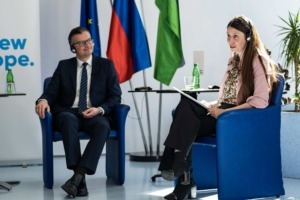 Joveva also mentioned the division that exists in the political and civil spheres in Slovenia, “They say no one should be excluded, while they are doing exactly that with those who criticise them. They talk about communists being to blame for everything in this world, let alone in our country, while using those very same methods themselves.” Šarec believes that Slovenia is not divided into two equal parts, “Seventy-five per cent of people think along centrist lines and entirely in line with EU values. They don’t care about politics enough to fight about it. That can only happen if someone provokes it.” At the same time, everyone thinks it is important, above all, to have a forward-looking view.
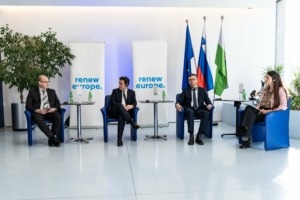 At the end of the round-table discussion, Stéphane Séjourné added, “At the moment, there are two different visions of society. We wish to avoid slipping into illiberalism or the decline of certain countries. I don’t want to dramatize it, but it’s really a referendum. These elections have a European momentum. We need to mobilise and motivate young people, who are difficult to engage today, because democracy is taken for granted. We were born into it, and we don’t know what it’s like to live without democracy. We must say that what we have achieved is the result of national struggles, revolutions, and the struggle for the independence of countries. We can lose all of this very quickly – we can see the instability in Russia and Ukraine and how societies can change completely. It’s always easier to demolish than to build.”
 What is more, unpaid traineeships perpetuate the cycle of “privilege for the privileged”. Why? Because it is only middle- and upper-class people who do not have to worry about rent, food, transport and all other living costs who can afford to undertake unpaid traineeships. But if a student cannot afford to work without being paid, they are automatically deprived of the skills that would enable them to get a better job in the future. This puts them in a fundamentally unequal position. So much for the argument of equality of individuals in the labour market.
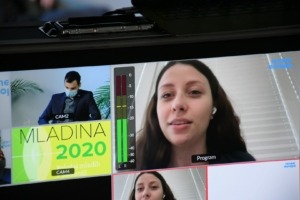 Similarly, Irena Joveva focuses most of her work on young people, who, she says, are equal, fully-fledged and indispensable members of a developed and modern society and deserve to be treated as such. “There are more and more young people who regularly experience loneliness and stress. Experts point in particular to stress-related disorders such as anxiety and depression, but also to eating disorders, anxiety disorders and behavioural and emotional disorders. The pandemic and the measures taken as a result of it merely compound all of them,” she said, also mentioning the impact and pressure from parents and social networks. As a shadow rapporteur on behalf of Renew Europe, Joveva will contribute to the report on the impact of COVID-19 closures of educational, cultural, youth and sports activities on children and young people in the EU, and make sure it includes the need to provide timely help to young people in mental distress and to improve society’s awareness of mental health issues.
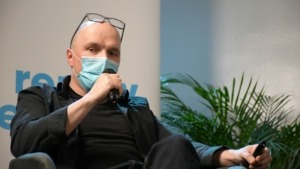 Andrej Naterer presented the results of the Youth 2020 survey, which revealed worrying trends: “Stress among young people has more than doubled, young people say they feel it most days. The proportion of young people who are lonely has tripled. COVID has contributed to loneliness, but not significantly, as loneliness was already increasing before COVID and will persist and increase once the pandemic is over. And there is also a growing presence of anxiety among young people.”
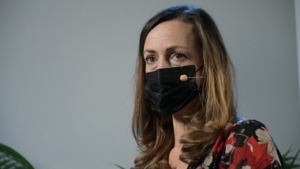 Andreja Poljanec also touched on the aspect of environment and peers, as being close to family and friends goes a long way towards adolescents not developing mental disorders. She would like to see changes in the curricula at all levels of education and that those who work professionally with young people would be equipped with the modern knowledge and skills needed for working with young people. Andrej Naterer also mentioned research showing that our sensitivity to stress has increased, while at the same time societal pressures are mounting. Activities that worked against stress in the past now add to it: “They, too, have a competitive element nowadays. If you do sport, there’s always someone better, if you do yoga, there’s always someone doing more asanas.” The findings show that good family relationships are the first line of defence, followed by good relationships within the extended family, in the neighbourhood and with friends. It is the spread of egoistic behaviours that we have been witnessing in recent years that is tearing us apart and increasing stress. The solution lies in improving relationships and in consciously withdrawing from stress-inducing impulses, including constant online presence. Klemen Selaković confirmed that depression is a disease of difficult personal relationships, but also stressed the importance of one’s own engagement: “One has to ask oneself if it really is the parents, mother, capitalism who are to blame for everything? If you believe that, then you are not taking responsibility for your own life.”
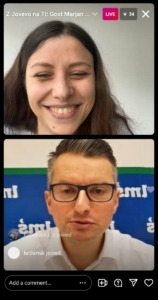 Since they have been in politics, the main source of satisfaction for both of them has been people’s response to their work. Joveva is keeping her campaign promise that she is there for the people who sent her to Brussels: “When you know that you have helped someone, answered their question or helped in a more concrete way, submitted a question for the Commission, asked a fellow politician a question, raised a topic in a meeting, submitted an amendment and thus actually changed the legislation.” Šarec added: “Irena and I both come from a working-class or farming background, our lives have not always been a walk in the park and we know that effort has to be put in to achieve results. Nothing has been given to us for free. This is also how we approach our work in politics. I don’t like snobbery and pretentiousness, I have always been happiest when I have been able to have direct contact with people.” Politics, he says, reveals who you really are.
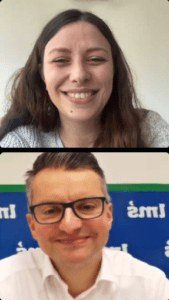 Meanwhile, the COVID-19 epidemic has not only exposed problems in the health care sector, but also the confusion thrown up by the measures dictated by the government. Šarec and Joveva agreed that, during the pandemic, the authorities’ communication with citizens was the primary problem. Šarec advocates softer measures in dealing with the epidemic, such as distancing, masks, hand and cough hygiene, self-testing of everyone, including those who have been vaccinated, and strict adherence to quarantine. However, he does not support compulsory vaccination. He added that, as a result, the LMŠ would not be able to work with parties that oppose all COVID measures, even if some people should find this a good idea.