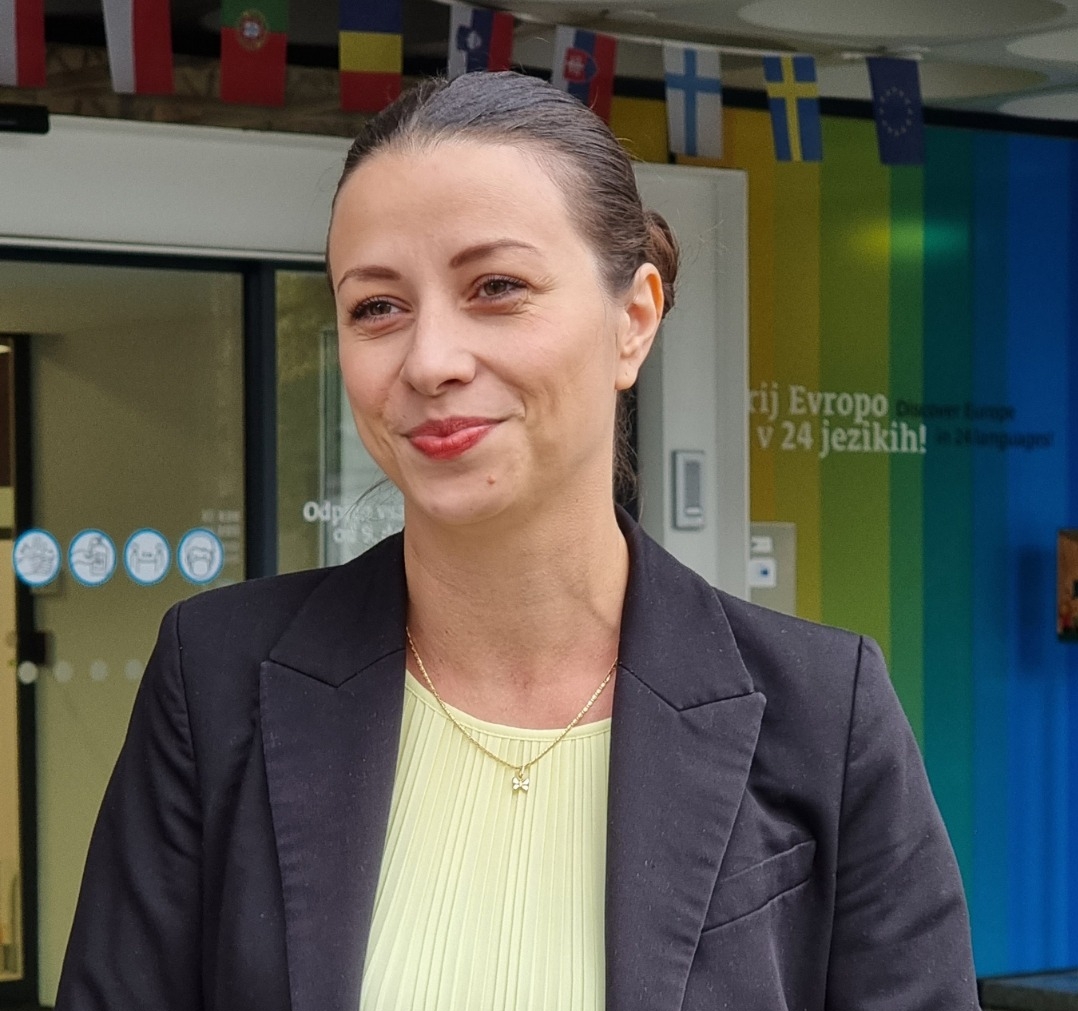
Just before the summer break, MEP Irena Joveva gave an interview to Liza Maja magazine, which was published on Thursday, 3 August 2023. In it, she touched on reconciling politics and family life, her insistence that companies respect the Slovenian language, the soon-to-be-adopted European Media Freedom Act and her other priorities. If you want to know what motivates her, what her approach to work is and who she has most in mind when fighting for a better future for the coming generations, then read the summary below.

”All three of them, always. All of them have shaped me and fulfilled me, allowed me to do what I love doing, what I believe in,” Joveva responded to the initial question of which of the careers she would put first: that of a journalist, a politician or a mother.

”In journalism, I loved getting to the bottom of a story, but now I’m pushing “from the inside”. With legislation, amendments, public appeals, like the one in the letter to the CEO of Apple.”

When asked how she juggles work commitments and family, she said that she takes it one day at a time, underscoring that that she is neither the first nor the last politician with a family and that this should not be deemed unusual in 2023.

”I don’t want this to sound trite, but in everything I do I always have her future in the back of my mind. I cannot fix everything that is wrong with this world as an MEP, unfortunately, but I can and I do try to change it for the better at least in some areas. Hoping that one day my daughter will be proud of everything I do.”

Regarding her latest initiative to fight for the accessibility of Slovenian in the digital world, she explained that things are moving forward. She pointed out that it is not only speakers of Slovenian who are being ignored, but especially all blind, visually impaired, deaf and hard of hearing people who continue to be marginalised through linguistic discrimination by multinational companies.

“And in the end: those of us who speak a foreign language… So what if we do? It is our right and our choice to use our mother tongue. This is why I wrote to the big companies present on our market, and did so in Slovenian. People supported my initiative, including Slovenian professionals in the field.”

The MEP met with respective company representatives and declared resolutely that she will closely monitor the progress – that she will stay on their case  and at the same time propose specific legislative solutions. She acted on her promise as a Renew Europe rapporteur on the European Media Freedom Act, where she advocated that a provision be added to the text to govern streaming content providers operating in the EU market.

”We cooperate in different fields, why shouldn’t inspection services cooperate as well? The idea is that an inspector in Slovenia could ask their counterpart in another Member State, where, say, Netflix is based, to resolve an issue. This would result in the legal transfer of competences, to put it simply. Slovenian is and will continue to be one of the official languages of the European Union. If it cannot be done the easy way, then we will have to use pressure and legislation to ensure that our language is respected by all companies present in our country.”

She emphasised the significance of this act for public information, as well as the media’s role in holding up a mirror to politicians so that they act responsibly. She stressed that she was not talking about the outlets engaged in propaganda, but the credible and objective ones.

”If the freedom of the media falls, democracy falls. And when democracy falls, we are in trouble. Unfortunately, this has already happened in several countries, including in Europe. I have personally met representatives of both the government and the media in, say, Poland and Hungary, and believe me when I say that we do not want to live in a society of enforced conformity.”

Finally, she touched on her activities within the Renew Europe group and in the European Parliament in general, where she sits on a number of committees. These include the Committee on Culture and Education, the Committee on Employment and Social Affairs and the Committee on the Environment, Public Health and Food Safety. Within the latter, Joveva recently became Vice-Chair of the new Subcommittee on Public Health, where one of her priorities is mental health.

A social label attributed to someone for being different, usually unjustified: stigma.

A state of physical and mental well-being, non-impaired functioning of the body and mind: health.

Unfortunately, stigma also affects health. Especially mental health. Stigma discourages people from seeking help in time. It leads to social exclusion, which worsens an already alarming situation even further.

Due to stereotypes about mental health issues and disorders, mental health is kept hidden and isn’t talked about. However, as the definition states, health not only signifies physical, but also mental well-being. This is not something we are sufficiently aware of, and the fast-paced, crazy world of (too-) high expectations and filters is not doing us any favours in this respect either.

This is where (co)decision-makers have to step in too. As Vice-Chair of the Subcommittee on Public Health, I am advocating for two key issues:

– to ensure that all young people with mental distress or disorders receive accessible, free and timely help, which is a crucial first step in successfully tackling their difficulties;

– to ensure that both the authorities and all other stakeholders raise the level of awareness about mental health issues.

It is critical to talk about mental health and thus shatter the stigma that is still associated with it. Each of us has difficulties in our lives, we all experience and deal with them differently. What is important is that they are actively addressed.

– Irena

I’m sitting on the sofa thinking. I’m thinking about the experience that has just come to an end, yet is constantly on my mind. My two-month traineeship has gone by in the blink of an eye. Not long ago, I was standing in front of the main entrance of the European Parliament in Brussels, where I was “picked up” by Irena’s assistant Žana, who led me through a maze until we arrived at the offices where I settled in comfortably and familiarised myself with my new working environment. The initial week was rather calm and I used it to get to know the city in miniature, as I like to describe the Parliament, as well as my new colleagues.

I was a bit nervous before arriving in the European capital, as it is not every day one embarks on a traineeship in an institution like the European Parliament.

However, I soon realised my unease had been completely unnecessary as I very quickly found my place in the team, who are relaxed and always ready to help. And so began my work, which has been fascinating and highly dynamic from start to finish. There were days or weeks when there was a little less work, but this was soon evened out by another week when the workload was significantly higher. This variation is closely related to what is going on in the Parliament. During the ‘green’ weeks, when MEPs are generally in their respective countries, there is not as much work as when, for example, they are attending committee or political group meetings in Brussels, let alone during plenary weeks. But not to worry, I always managed to get all the work done. Being a trainee in Irena’s office doesn’t mean you are chained to a computer. I have had the opportunity to follow political group and committee meetings and, of course, plenary sessions. Through this process, I became familiar with the contents of many different documents, which covered topics such as the media, environment, and health, to name just a few. I also had the opportunity to listen to important guests from other European institutions, as well as heads of state and other distinguished personalities. My work included preparing content for social networks and assisting in the official photo-shoot of the MEP. I even took some photos of Irena myself as she was attending meetings or giving a speech at a session. Another memorable experience was when representatives of the European Roma Community visited the Parliament for a meeting with the MEP. I welcomed them and accompanied them to the meeting, and later I escorted them to the European Commission premises, where I assisted with translation during their discussion. As you can see, the work is never monotonous and as a result of the variety of tasks I was been given I have gained a broad spectrum of knowledge and skills.

Walking through the Parliament’s corridors on my way to a meeting or simply to have lunch in the canteen, I was captivated by the sheer number of people of many different nationalities speaking many different languages, which I tried to recognise and understand. On one such occasion, I had a pleasant surprise. I was walking past the media centre, which is available for Members to record statements, and I ran into a huge crowd of people. Bigger than usual. I successfully made my way through and then I noticed that it was the Parliament’s President, Roberta Metsola, who was recording a statement. That was the reason for all the commotion. Prior to my traineeship, I would never have thought that I would have a chance to stand less than a metre away from the President. This is just one of the thrilling things that can happen in the Parliament, and such coincidences make the traineeship even more exciting. But the Parliament is not merely a place for political muscle-flexing, for meetings and office work. On the ground floor of the main building, you can find all kinds of services. Next to the canteen and other food shops, there is a dry cleaner, a hairdresser and a newsagent where you can buy postcards or drop off parcels. In fact, this floor looks more like a shopping centre than a European institution.

Just before the end of my traineeship, I got to attend a Strasbourg plenary. I must say, it was a remarkable experience, quite distinct from the rest of my traineeship in Brussels. In France, the nature of the work is different. Not so much in terms of my duties as a trainee, but with regard the whole dynamic of everyone there. The corridors of the Parliament’s building in Strasbourg are even more vibrant and confusing and even more packed with people rushing to political group meetings or to voting sessions in the plenary chamber. There really is not much time to rest, because the agenda is full of thought-provoking debates. If, despite the signs, you get lost as a trainee, don’t worry. Most of the people I spoke to assured me that they still manage to get lost, even after repeated visits to the institution. Despite the long working days, there is time for a visit to the city. Strasbourg captivated me completely and is very different from the Belgian capital. It is smaller, more homely and, above all, much cleaner. The little houses in the heart of the city are quite charming and the huge baroque cathedral is breathtaking. It is a must-see during the day and in the evening when the lights of the city come on, which adds to the charm. There is a river boat from the city centre to the Parliament several times a day. I also recommend tasting a traditional tarte flambée.

And if I return to Brussels for a while, it is evidently not only home to European institutions and the political wrangling. Even though not many will agree, I find the Belgian capital just as beautiful and interesting to explore. It is true that it has a reputation of grey and sour weather. That is why it is all the more wonderful making the most of every ray of sunshine on a work-free day. Apart from all the famous landmarks such as the main square and Manneken Pis, I was struck by the abundance of parks, where I often went for a stroll or spent time socialising with other trainees I met while in Belgium.

The regional cuisine may not be extraordinary, but there are plenty of restaurants from all over the world to fill the stomach. Did you know that French fries supposedly originate from Belgium rather than France as the name suggests? You will be able to savour truly outstanding French fries, often paired with a vast selection of sauces all of which you cannot sample in only two months. And heaven forbid I should omit to mention the excellent waffles and Belgian chocolate. Other than that, I preferred to stick to the tried-and-tested dishes. Brussels is also a great starting point for day trips/. The public transport permits you to escape and explore other, more idyllic cities around the country over the weekend. I would suggest Brugge, Ghent and the less familiar Dinant which nevertheless deserves a visit. There is never a dull moment in Brussels, and the decision about how to spend free time depends purely on one’s interests.

I would like to use this opportunity to express my appreciation to everyone who kept an eye on my work and put up with my queries and lack of knowledge. My sincere thanks to MEP Irena for the opportunity and the warm welcome to her team. Even though I was certain that Irena is a laidback and amiable person, I was positively surprised by her humanity. She and all her colleagues really made me feel equal, as a full member of the team.  Thank you to the assistants Žana and Rok from whose invaluable knowledge and familiarity with the legislation I was able to constantly learn something new. Last but not least, a big thank you to Elma, who let me share her office, for all her good humour and positive energy and, of course, for all the advice, guidance and suggestions she was most happy to share during my two months on the job. Thank you, Elma, for keeping a watchful eye on me and making sure that I fitted in smoothly and without any difficulty. Thank you also to the local assistants Jasna and Tilen. If it weren’t for you, my experience would have been much less exciting and insightful, so thank you all very much, you really are a great team.

Finally, this experience has been unparalleled and unforgettable. It was an adventure that will stay with me forever. To all of you who may be thinking about applying for a traineeship, I urge you to do so. Forget about fear and uncertainty, be bold and step out of your comfort zone – you won’t regret it.

– Domen Bajde


On Monday 17 July 2023, MEP Irena Joveva took part in the exchange of views between the European Parliament’s Committee on Culture and Education and the European Commission on the implementation of the European Solidarity Corps programme, for which she is rapporteur on behalf of her political group Renew Europe. The MEP made it clear in her statement that volunteering is the backbone of our society and will become even more vital in the future. At the same time, she highlighted certain shortcomings of the programme that need to be addressed and remedied. It is an excellent programme, she declared, but there is still a lot of room for improvement.

According to Joveva, this is an opportune time to tackle the deficiencies of the programme, as we are halfway through and there has been enough time to figure out what to do and how.

She then pointed out the need to raise the profile of the programme, and broached the financial difficulties, as contributions have not kept pace with inflation, leaving organisations and volunteers often struggling for survival.

At the same time, many of the issues are digital and technological. As Joveva noted, existing digital tools, specifically the search and match criteria, are not user-friendly. The same applies to the online language support system. She called on European Commission representatives to address the issue properly.

She also touched on the process of obtaining a quality label, which is lengthy and complex, while the labels are not available in all EU languages:

“It would be welcome and, above all, fair to all citizens of the Union that this is examined and rectified.”

Joveva also drew attention to the general funding of the programme:

“While budget resources are still low, we are seeing – contrary to the original plan – that more and more people are signing up for long-term activities. I really hope that the funding will be increased accordingly, so that we can provide all interested young people with a high-quality opportunity within the Solidarity Corps. Of course, I am aware that there are constraints on the MFF, but I nevertheless want to make sure that our programmes do not lose what they have already got.”

The MEP concluded her speech on an optimistic note, saying that she is looking forward to continuing work on the programme, as she is confident that she and her colleagues will be able to respond to the challenges and propose workable improvements.

You can watch the full speech here.

The process by which something that is worn out, damaged, becomes as good as new.

The definition of restoration.

There are many things on our planet that are worn out, damaged. Many of them so much so that, unfortunately, the process described above is impossible. And, sadly, the vast majority of it is down to humans. But there are still things that can be fixed. Restored. At least partially.

And one would expect – at least those of us who are aware of our responsibility to the planet – that politicians would be ‘fighting each other’ to go down in history as the greatest advocates of the environment. Fighting to show more ambition, to protect nature more.

But the opposite is happening. Self-serving politicasters and opportunists prefer to conspire against the legislative text that is the least suitable to be the subject of political infighting and, above all, of false information.

I am speaking about the Nature Restoration Law, which we voted on today. The manipulators have failed, the bill was not defeated, negotiations will continue. This is a victory, but with a bitter aftertaste.

Those of us MEPs who are genuinely concerned have shown that we care. For the environment, for climate neutrality, for the future. On the other hand, the other MEPs, too, are genuinely concerned and have shown that they care. About themselves.

I have a message for them. And a few questions.

… When speaking about the restoration of ecosystems. Land, coastal, freshwater, marine, urban ecosystems. The forest ecosystem. The agricultural ones! When speaking about restoring pollinator populations. About natural environments that have already been destroyed, damaged, exploited.

How can there still be people who claim that this legislation is “dangerous” or “unnecessary”? This is yet another classic case of politicising the matter to scare the masses. They spread fear by claiming, for example, that Article 9 of this law which aims to increase land conservation and biodiversity will drastically reduce food production, which is completely misleading.

Should we really do something for our bees and other pollinators, or should we just talk of them with pride when enjoying honey or talking to someone from abroad?

What about all other animals, plants and their diversity? Are we really not tearing up the ground beneath them – sometimes literally?

Where we have drained peatlands, have we really not caused the collapse of the ecosystem? What if we cut down a forest and don’t replace it?

Do we want more trees alongside new motorways, new high-rise buildings and shopping centres? I would dare to say that the planet is already “boiling” enough.

The renewal rates that we are talking about hover around some ten per cent, and in my opinion they are already too low, while some would prefer to halve the ambition. In fact, certain amendments adopted today have significantly weakened the text.

I repeat: it’s about RESTORATION – and only as a proportion of the total damage. Damage that humankind – we, as society, our economies, our desire for more – has inflicted on animals, plants, the environment.

And the worst thing? That it is not “only” climate change (which is reflected in long dry spells, devastating floods, hail and other unpredictable crop-destroying climatic events), biodiversity and ecosystem loss, including that of pollinators, and (excessive) pest control that pose the biggest threats to food security, fisheries, agriculture and forestry. Rather, such threats also originate from political manipulators, opportunists and hypocrites.

… Who score political points on the backs of farmers. The latter have long been the victims of insufficient legislation that would protect and preserve nature and the environment, and guarantee them greater crop stability and thus a better livelihood. I therefore also have a message for everyone in the agricultural industry. You must be aware, I am sorry to say, that the representatives of the European People’s Party and all those who opposed the proposed legislation under the pretext of ensuring sufficient agricultural land and food security, have achieved its exact opposite.

As a society, we put a value on everything. In terms of a price, profit, capital. We place a much lower value on human beings. And none whatsoever on nature.

It’s high time we ALL started to realise what is really important for life on this planet.

Gluttony … will eat us up.

– Irena

Political games are one thing, but to unjustly slander a country with baseless claims just to please an illiberal populist is truly unacceptable. I think it would be fair to the Slovenian people if you explained to us in what way and where you are “witnessing the collapse of the rule of law and the political takeover of the media in Slovenia”? That is the least you can do. Until such time, I ask you to refrain from slandering my country without a legitimate basis.

You have now read a paragraph of an email I sent to the leader of the largest political group in the European Parliament and to all its MEPs. Do you know who that is?

Someone who is blatantly ignoring the facts. Someone who is evidently, without any remorse, consolidating the populist right and serves as a mouthpiece for their absurd and manipulated theses. Someone to whom I also wrote: “I know you know very well who their ideological allies and mentors are.”

Let the political family that blindly takes on the distorted claims of the populist agitators at least present the arguments underpinning their assertions. And who is really behind them. This is the least we are owed, if they are ready to indiscriminately bad-mouth our country. It should by now be obvious to them who it is that they are backing in Slovenia. It would be preferable that they help elevate the political culture of the right wing in our country, given its current lamentable state. I know that it is not as dismal (yet) at the European level. But it is high time to reflect on whether everyone wishes to go down this road.

It doesn’t matter whether we are liberal, conservative, left, right, top, bottom or what have you, we can disagree on many things, but we should all, without exception, stand together when it comes to the most important thing: defending the rule of law, our liberal democracies, and – as far as I’m concerned, most vital of all – truthfulness. And, if truth be told, it is sad to see how the historic values of decency, respect and human dignity, which are supposed to be the fundamental values of this largest political family, are being trampled on by radical factions. Critical reflection is always in order. Double-checking the information you get from the aforementioned radical factions is even more in order.

I do not hesitate to express criticism when it is appropriate. I do not care for instructions, partisan interests, loyalty at any price. The only loyalty I care about is loyalty to the people. But, ladies and gentlemen, the European Commission’s 2023 Rule of Law Report for Slovenia simply cannot be criticised. Unless, of course, one is instructed to do so. Or is pursuing certain interests. Or there is a price attached.

Or because one is living in a parallel reality and, above all, in the past.

But… facts simply don’t lie. And this report is based purely on facts. It is the result of thorough analysis and verifiable information, which finally and rightly places Slovenia back in the company of stable democracies in Europe.

Let there be no doubt: the previous reports were also based solely on facts. The previous two, for example, expressed great concern about the accelerated attempts to dismantle the country’s fundamental institutions. Guess under whose government.

The most recent report, however, clearly highlights progress. Including in the field of media freedom, for the first time in two years. It explicitly mentions action taken to remedy the situation of the Slovenian Press Agency, and the importance of the amendments to the RTV Slovenija Act for ensuring the political independence of the public broadcasting service. It also notes progress in the areas of civil society and justice.

Of course, certain criticisms remain. Of course, unresolved issues remain. But they, too, are being resolved. And – what is more – they date further back than a year.

That’s the difference.

The difference when it comes to instructions. Interests. Loyalty. Between conservatives, radicals, liberals. Between the previous and the current government.

That. Is. The. Difference.

– Irena

On Tuesday, 4 July 2023, MEP Irena Joveva responded to a request from POPTV’s 24UR programme for a comment on the new amendments to the Act on the public use of the Slovenian language and on the upcoming new European legislation, which could resolve at least part of the problem with discrimination against Slovenian in the digital environment. As she explained, the European Media Freedom Act, which she is helping to shape as one of the European Parliament’s negotiators, will to a certain extent also regulate streaming content providers on the European market. “We simply must not tolerate discrimination against the Slovenian language,” she said resolutely.

The MEP expects that Article 14 of the European Media Freedom Act will include a provision on coordination among regulators, which would simply force foreign companies (specifically streaming content providers such as Netflix, Disney+ and Amazon Prime) to respect national laws and all official languages of the European Union, even if a company officially does not have an office or headquarters in a certain Member State, say Slovenia.

In her contribution, Joveva explained the idea using the example of a Slovenian inspection service establishing an irregularity or violation constituting discrimination against Slovenian as one of the official languages of the European Union. In such a case the said inspection service will be able to apply a certain mechanism and request inspection services of another Member State – e.g. in the Netherlands in the case of Netflix –, to see to the matter.

You can view the interview here.

Yes, I’m going to bring up the European Media Freedom Act again. But when you find out why (just read on), you’ll understand.

You all know by now that I am continually confronting multinationals operating on the Slovenian market, who are discriminating against the Slovenian language as they go. My team and I have been giving a lot of thought to what we can do. Send a letter, urge, convene meetings, explain… all well and good, but unfortunately not enough.

It is through legislation that companies are compelled to introduce the necessary changes, especially those who confidently declare “we don’t have to”. Well, sooner or later you will have to.

First, there’s the national level. The Ministry of Culture has finally submitted the envisaged legislative changes for public consultation. I intend to take part in the process within the framework of my competences. I hope for an ambitious, sharp, unambiguous amendment of the law.

And then there’s the European level. With its European Media Freedom Act. And Article 14 on the coordination among regulators. I am determined to include a provision in this legislation – which will have the form of a regulation, meaning that Member States will have to transpose it exactly as it is agreed in the negotiations – that will simply force foreign companies to comply with our law, even if they are not officially established in, say, Slovenia.

How? On the basis of this provision, a Slovenian inspector, for example, establishing that Netflix is discriminating against Slovenian, an official EU language on the EU market, will be able to make use of official mechanisms to request the inspector in the country where the company has its offices or a head office (in the specific case of Netflix in the Netherlands) to put the matter right.

I really believe that this provision will be adopted, as at this point none of the other negotiators are voicing any issues with it. Of course, the process then continues with negotiations with the Member States and the European Commission, but I am confident that we will succeed – I am confident that I will succeed, because I understand how important this is! – and that, in parallel to the Slovenian legislative amendments, we will FINALLY make progress in this respect. Give Slovenian the place it deserves.

It is our language, our right and our choice.

And that’s what I spoke about in my contribution for POP TV’s 24ur programme today.

Greetings from Brussels

– Irena

On Wednesday, 14 June 2023, MEP Irena Joveva discussed the implementation and delivery of the Sustainable Development Goals (SDGs) at the plenary session in Strasbourg. She stressed that the time for action is now, as 2030 is just around the corner. The challenges are deepening and we seem to have learned nothing, she added.

“Ever since the signing of the Sustainable Development Agenda, the EU has been committed to leading the way in achieving the goals. We want to achieve them by 2030, don’t we?”

As Joveva continued, the Green Deal adopted during this term of the European Parliament, marked the first steps in the right direction, but then we were hit by a pandemic. After stepping together to resolve the health situation, a war broke out on our continent, which was followed by the energy and financial crises. She expressed her concern that we are not prepared for all the problems that continue to arise.

“Meanwhile, inequalities are growing and environmental, health, financial, food and social challenges are deepening. We should have learnt that such all-encompassing challenges cannot be solved with minor, fragmented sectoral solutions. It seems that we have not.”

Joveva also highlighted the fact that 2030 is just around the corner and still no strategy and financial plan for the Agenda’s implementation have been presented, despite the European Parliament having called on the European Commission to prepare one already last year.

“Let’s make sure that the current appeal proves more successful because it’s time for action. For the good of the people, the planet, prosperity and, last but not least, peace and freedom.”

Background:

This year’s report is a follow-up to last year’s report, which aimed to strengthen the implementation of the Sustainable Development Goals in the areas of governance, finance and international diplomacy. It contains strong calls for a long-awaited high-level strategy for the implementation of SDGs, a strengthened civil society, improved monitoring and mobilisation of resources. The report should be seen as an effort by the European Union ahead of its participation in the annual High-Level Political Forum organised by the European Commission this July, which will focus on accelerating the implementation of the goals, post-COVID-19 recovery and the overall implementation of the 2030 Agenda.

You can watch the speech in Slovenian in full here.

Foto: Genevieve ENGEL

The Parliament’s Special Committee on the COVID-19 Pandemic, of which MEP Irena Joveva is a member, has adopted recommendations to improve the European Union’s crisis management and preparedness for possible future health emergencies. MEPs analysed the impact of the pandemic, assessed the effectiveness of EU and national measures, and made specific recommendations to address gaps and weaknesses in the response.

Key health proposals put forward by the Special Committee include increased investment in healthcare, the introduction of surveillance plans on emerging health threats, the implementation of stress tests on national healthcare systems, greater transparency of joint procurement, increasing the EU’s strategic autonomy with regard to key pharmaceutical ingredients and medicines, and the development of an EU strategy to deal with possible similar pandemics in the future.

To safeguard democracy and fundamental rights, MEPs are calling for better protection of the right to information and freedom of expression, enhanced crisis communication and transparent decision-making procedures, parliamentary oversight at both EU and national level when adopting emergency legislation, and concrete measures to support marginalised communities, minorities and disadvantaged people during crises.

To tackle the social and economic impact of the crisis, the Special Committee’s report calls, among other things, for meeting the needs of the growing elderly population and for setting standards for teleworking conditions throughout the European Union.

On recommendations for action at the global level, MEPs call for increased international investment and strengthened international health regulations.

The report of the Special Committee, which has now concluded its work, is expected to be adopted by the European Parliament at its July plenary session in Strasbourg.