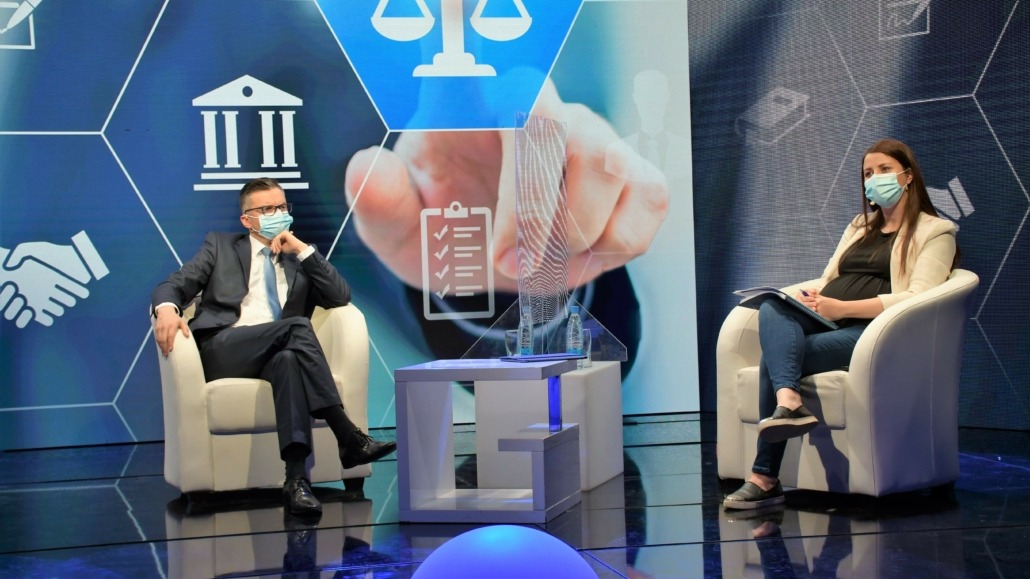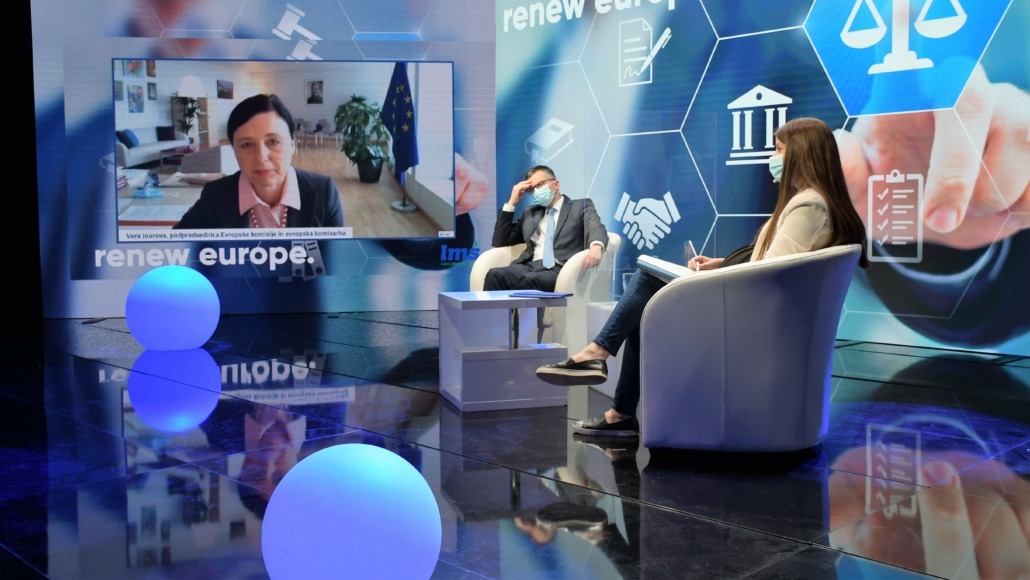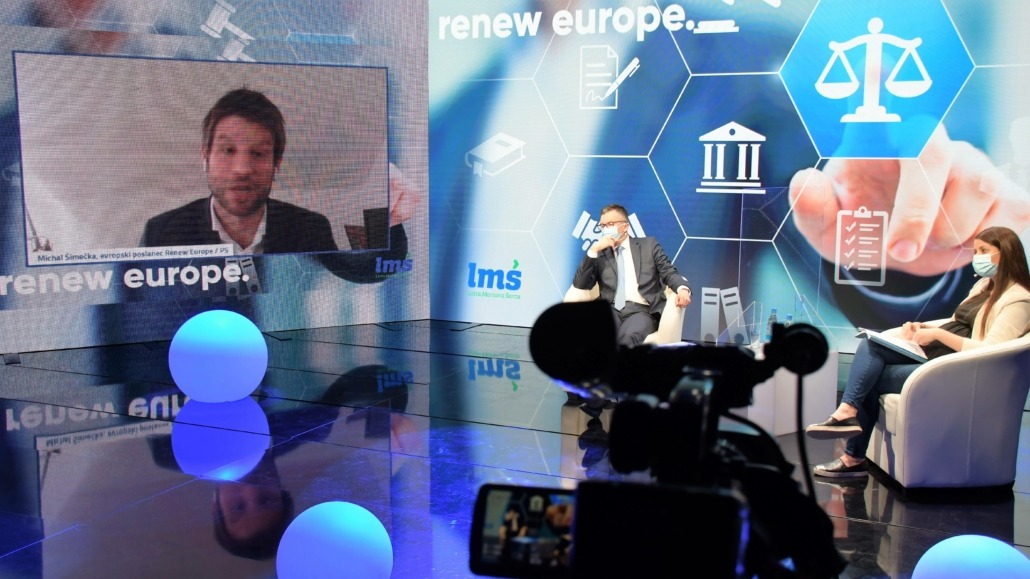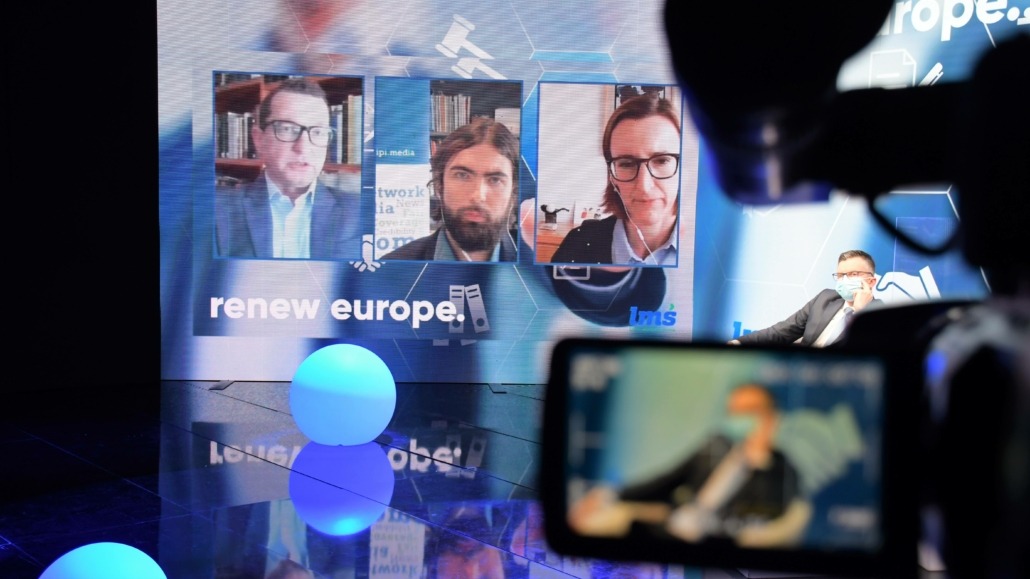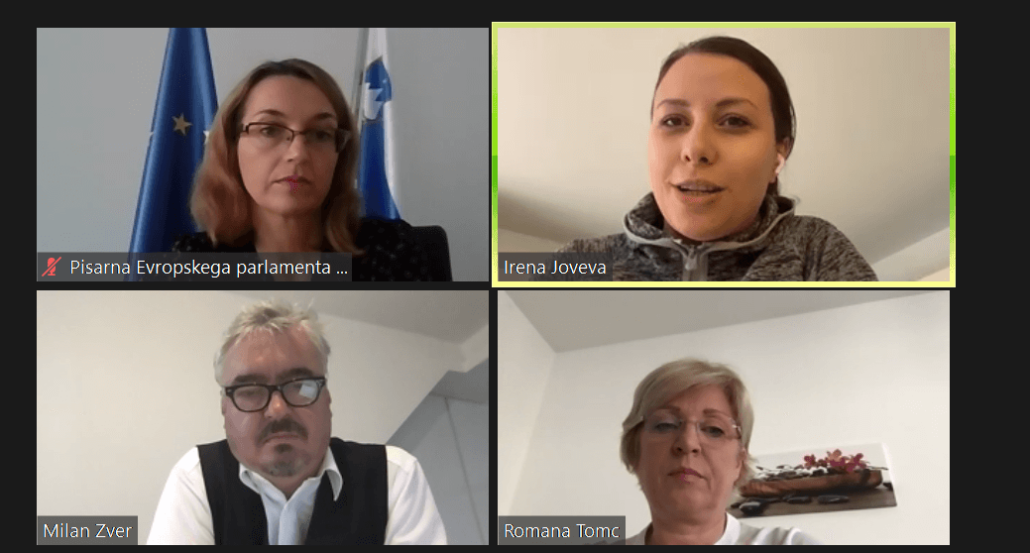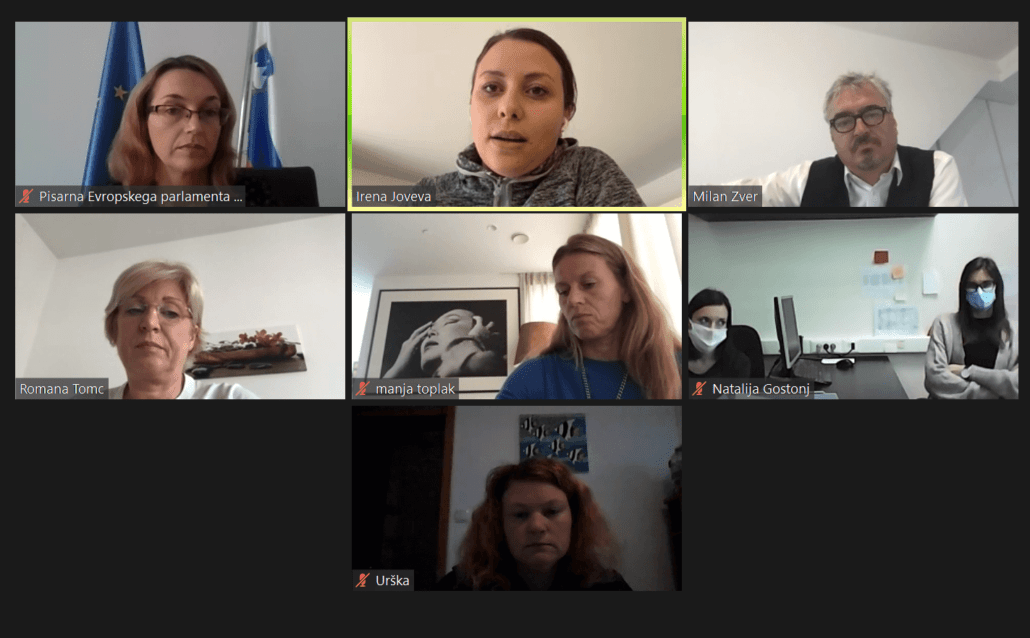
On Tuesday, 6th April 2021, as part of the European Parliament Ambassador Schools project, students from the Novo mesto Grammar School organized a Zoom talk with MEP Irena Joveva. The main focus was on how the EU is managing the current challenges.

At the beginning, MEP Joveva gave them an overview of her regular working hours in Brussels (before and during the pandemic) and technology used in remote work during the pandemic. The students were particularly interested in the MEP’s life so far, from her multicultural upbringing and first job to her career in journalism and her decision to become active in politics.

During the one-hour debate, the most topical issues of vaccines and vaccination, the lack of communication, and the phenomenon of infodemic could not be overlooked. Joveva said that the European Union’s vaccine strategy was good and quite ambitious, but it only looks good on paper. Unfortunately, its implementation in practice is far from optimal, starting with the lack of sincere communication — both from the profession and, in particular, from politicians — with citizens. The different information on vaccines: the number of vaccines supplied; changes in national vaccination strategies; age limits; side effects – which changed from day to day – caused discomfort and mistrust.

“For citizens to have confidence in vaccines and the vaccination process, there needs to be honest two-way communication, and unfortunately, there is not; not only in Slovenia but also at the European level. Since decision-makers were mostly unable to clearly explain what was happening, people started to believe all kinds of misinformation and conspiracy theories circulating on social networks. That is why we in the European Parliament are going the extra mile for transparent information about current events to restore confidence in vaccination because it is our only lifeline for a return to, so to speak, a normal life.”

The students then turned the discussion on the pandemic toward digitalization and asked the MEP to comment on the rapid shift towards distance education and the use of technology used at work. Joveva admitted that she had quite a few problems with different apps, even though she is a member of the younger generation.

“Technology is advancing so fast that it can be challenging to keep up. The sudden increase in the use of technology in work and education has highlighted the fact that in many countries, we still have inadequate digital conditions in the 21st century — from a lack of access to computers or the internet to a lack of digital competencies. Since the pandemic, the European Parliament has adopted several resolutions on tackling the inequalities identified and on the future development of European education systems in the context of Covid-19. Gaps in digital education need to be bridged, as we in the EU were already aware before the pandemic. The Commission has been working with the profession to reform education at the EU level. The result of this collaboration is the Digital Education Action Plan, which will have a very significant impact on the functioning of established education systems in the future, in line with the digitization of the EU,” explained Joveva. She then continued that the coronavirus epidemic has indeed led to a significant leap in transferring learning activities to online tools. “In the future, it will be crucial to continue to raise young people’s awareness about the safe use of the internet. We have addressed this in the Digital Services Act, which significantly improves mechanisms for removing illegal content, protecting users’ fundamental rights online, flagging misleading and false information, and making algorithms transparent.”

At the end, Joveva asked the students to be curious, to ask questions, and, above all, to be actively involved in politics even after the Ambassador School project is over. “After all, you are the future of a better Europe for us all!” Two students summarized their impressions of the roundtable: “The conversation with Irena Joveva was very informative and interesting. We covered a wide range of topics, from the workings of the European Parliament, technology and the current situation, to the problems caused by the epidemic. I was very impressed by her sincerity and attitude towards us students.” (Anteja Ratajec)

“A conversation with Irena Joveva opened the door to the European Parliament. She briefed us on the work of the EP as well as on her work. During the discussion, we touched on some topical issues such as the fight to contain the epidemic, the work of MEPs “from home”, the position of women versus men in politics, and media freedom. She also openly presented her views on these topics and encouraged us to be curious, interested, and critical.” (Ajda – Lea Jakše)


On Tuesday, 6th April, 2021, students of the Nova Gorica Grammar School, who participate in the EPAS programme, organized an online conversation “OPENLY with Irena Joveva”. The discussion was about the current situation in the EU relating to the pandemic, climate change, and other pressing issues.

In the opening remarks, everyone pointed out that the pandemic has changed priorities, while also highlighting some of the EU’s shortcomings. For more than a year now, the situation has brought severe economic and social hardships that will further stratify society. The effects of the pandemic on the labour market show striking inequalities between jobs. The students were interested in whether the stratification of both Slovenian and European societies will increase or whether this will be an opportunity for reform and solidarity. MEP Joveva expressed concern that the former would happen.

Certain sectors have been closed for too long. Certain micro and small enterprises are subject to revenue losses. In the long term, this means an erosion of jobs and entrepreneurial capital. A strong focus on tackling inequalities is needed, and in the EU many measures have been taken in the last year to mitigate the effects of Covid-19. The Recovery and Resilience Fund, for example, is truly historic and probably by far the most important in this context.

She made it clear that this is not just a sign of solidarity and unity between the Member States because this fund is changing the very fabric of the Union. “Those countries that make better use of these opportunities and resources by preparing good national plans will be in a much better position. The ‘fiscal stimulus’ as we have it now is the biggest and most important for the next decade, and is precisely designed to prevent greater social disparities from arising.”

At the students’ request, Joveva also provided some information on the environment. “Today, in many places — also thanks to Covid-19 — we are indeed breathing fresher and cleaner air, but unfortunately, at least in my opinion, this will not be maintained once the pandemic is over. History shows that a sudden drop in emissions has always had a short-term impact and has only increased back to the same level or even higher as the economy recovers.” However, she also expressed  hope that the “corona crisis” would provide a further boost towards a  green, sustainable economy. The Commission has made the environment a key priority since taking office and presented a Green Deal to make Europe the first climate-neutral continent by 2050. “Also to continue achieving the goals of this agreement, we have clearly defined in the Recovery and Reconstruction Fund that 37% of the national plan must be dedicated to climate. This is a safeguard that countries will simply have to respect.”

The MEP concluded her talk with a call to young people to be honest, curious, and active: Ask questions! And, unlike too many Slovenian politicians, use cultural dialogue. Use your head and stay true to yourself.

So, a digital green certificate. The title itself seems rather unfortunate to me, but that is the least essential thing in the whole story at the end of the day.

Yesterday, the European Parliament voted on whether to consider the proposal for a regulation on these “COVID-19 certificates” under the urgency procedure. I voted against the majority, including the majority in my political group. Therefore, I voted against this proceeding. Let me explain my decision.

The first thing you need to know is that the European Commission proposed introducing these certificates. The second thing you need to know is that the speed of adoption of the regulation will ultimately depend either on the Council or on the Member States.

And in between is the European Parliament. It is the only institution of these three with representatives directly elected by European Union citizens. So, I am not an MEP to vote solely as the European Commission tells me, or as the political group I belong to tells me, or as the Prime Minister of the country I come from tells me. Every time I make a decision, it is based on all (!) the information and my conscience.

We have had long discussions, meetings, and exchanges of views on these certificates, both at individual committees and political group meetings. The majority — with the European Commission at the head, of course — insisted on the urgent need of the urgency procedure, saying that anything else would be a delay, and we are in such a hurry with these certificates.

OK, let’s say we are really in a hurry. What would be the real difference between an urgent procedure and an accelerated procedure? The advocates of this urgent procedure have stressed that this procedure, and this procedure alone, would allow everything to be adopted by the summer.

However, there is no time difference in the timelines of the two procedures. Even with the “accelerated procedure”, the regulation could be approved by the summer – just like with the urgent procedure. There is one other difference between the two procedures. A key difference – The “Accelerated procedure” is more thorough. It would facilitate a proper debate and involve members of the parliamentary committee(s).

So, with this option, we could improve the regulation and regulate it so that we are confident it will NOT discriminate and will NOT contradict people’s fundamental freedoms and rights. But what happened now? Now we can only rely on the European Commission (and the Council) to take all this into account… as, unfortunately, we took some of our own powers away with yesterday’s vote. Sadly.

Why did this happen? The problem arose from fears of infighting in the European Parliament over which committee should have the power to decide on the regulation. The Transport and Tourism Committee and the Environment and Public Health Committee are expected to challenge the competencies of the Civil Liberties and Justice Committee, which could indeed lead to a deadlock. In other words: because of possible internal squabbles, childish squabbles, the European Parliament is arbitrarily (!) deprived of the possibility of a comprehensive examination of the regulation on digital green certificates. A regulation which, by the way, is not only technical but also political. I don’t think it is the wisest move to have weakened parliamentary involvement in this story in these times of crisis.

The European Commission initially tried to bypass the European Parliament and adopt only “guidelines” on this regulation. In other words: they did not want a legislative proposal at first, but then they realized that this was not possible, so they started to vindicate the urgent procedure. And now we are where we are. Where the adoption of the necessary procedure will not change anything in practice regarding the timetable, it may change everything else.

We all already know that these certificates will, sooner or later, become a reality. I will not implement them, and you will not implement them, I know — but there is no point in sticking our heads in the sand. There is no point in misleading you and telling you how everything can still turn around. It won’t. The certificates will become a reality. And if we already know that they will be a reality, then we should at least design them in such a way that they do not infringe on anyone’s rights.

But there are still no answers to the million unanswered questions. There are many in the fields of ethics, law, technology, and — ultimately — healthcare. Most of these are about vaccination itself. How much vaccination can we expect by the summer? What will happen to those who will never be able to vaccinate because they can’t be due to various risks? Will they be tested again and again? Will it be free of cost every time? What will happen to those who just do not want to be vaccinated, which is also their right? How will counterfeit certificates be prevented? How will discrimination against people who, for example, are not skilled in using modern technology be prevented? What will happen to the validity of these certificates? Which doors will these certificates open? Travel? Restaurants? Concerts? What will happen to those people who have been vaccinated with vaccines that are not (yet) approved by the European Medicines Agency (EMA)?

Although I agree with the fast-track procedure between the two co-legislators, I just cannot get past the following point of view: Suppose there is anything urgent in this procedure. In this case, the regulation proposal should be scrutinized to ensure that it is considered in its entirety and ensure that all concerns are taken into account. The purpose of this system must not, in my view, go beyond facilitating travel. As a matter of fact, that must be their sole purpose.

Meanwhile, something else is being forgotten in all this. By far the most important. The importance of trust. The effectiveness of these certificates will depend on citizens’ trust in them. If citizens do not trust them, there will be less sense of responsibility and less sense of awareness, which are both crucial. No matter how we will travel, it will be an individual’s decision on how to act: wise or foolish, with or without the certificate.

Irena Joveva

Photo: EP/ENGEL


On Tuesday, 27. October 2020, members of Committee on Culture and Education exchanged views with Commissioner Mariya Gabriel and gave their thoughts on the situation on the Hungarian University of Theatre and Film Arts. 

Thousands of people have formed a chain in the streets of the Hungarian capital Budapest in protest at what they say is a takeover of a top arts university by the country’s government. Demonstrators fear a new board at the University of Theatre and Film Arts, led by an ally of Prime Minister Viktor Orban, will ruin its autonomy. It is the latest battle, and possibly last stand, against the Hungarian government’s attempt to seize power in independent institutions of all sorts, including cultural ones. Demonstrators demanded autonomy for the school and freedom for artistic endeavour and education.

The university is the seventh institution to be transferred to the control of private foundations where the board of directors are selected by the government. The government denies claims that it is limiting freedom of expression, and says the privatisation of this and other universities will make them more competitive.

MEP Joveva expressed her full support to the students and extended her congratulations on their strength, efforts, and fight for their university. “I hope you will manage to free the chains the government tries to put onto you.” Brilliant artists have emerged from this university and Joveva hopes they will continue to do so – in all freedoms that belong to them. The government has been systematically strangling media freedoms, democracy, and freedom of speech over years now, this just being the newest peak, she added.

CULT members also discussed with Attila Vidnyanszky. He was recently appointed to chair the board of directors and he made clear what the 155-year-old institution’s new direction would be: he wanted a “different kind of thinking” at the university, adding that existing classes would be kept with some ephasis placed on patriotism and Christianity. That is why MEP Joveva asked him: “What does this even mean? Is the meaning of your patriotism to suppress everything that does not comfort to your own ideas and values?” She continued that hiding an ideological battle under the facade of alleged increased competitiveness is a dangerous move we have seen before.

MEP Joveva also had a question for the Hungarian Minister of State for Economic Strategy and Regulation, Laszlo Gyorgy. Her questions and the speech in full length can be watched underneath:

If you are interested to know a little bit more on this matter you can read this article.


On Thursday, 22 October 2020, MEPs discussed the serious security threats posed by the sale of European Union passports and visas to third-country nationals. Offering citizenship in exchange for cash undermines the foundations of democracy and exposes our society to corruption. The problem of the so called system of “Golden visas” was firstly pointed out by investigative journalists. The media working group of the European Parliament, of which member is also MEP Irena Joveva, has therefore prepared a statement with which they want to draw attention to the importance of investigative journalism.

The Media Working Group in the European Parliament: Scandals around „Golden Visas” show the importance of investigative journalism

Today the European Parliament debated the serious security threats caused by the sale of EU passports and visas to citizens of third countries. In the past few years, a number of member states offered so-called “golden visas” where wealthy citizens could buy long-term visas, residence permits or even citizenship of EU Member States by taking part in certain investment schemes. These dubious schemes in various forms operated in such States as Bulgaria, Cyprus, Hungary, Malta and Portugal, to name a few.

After years of delay, the European Commission is now ready to step up and take action against these schemes in the case of Cyprus and Malta. Offering citizenship for cash is undermining the very basis of our democracy, and such practices in one Member States are affecting all 27 EU Members.

The truly international efforts to stop citizenship-for-cash regimes became possible because of the efforts of a large number of dedicated and courageous investigative journalists from a number of countries. We are truly grateful for their work. They revealed how people who were allowed to stay within the EU were causing a security threat. Many of the beneficiaries of these schemes have built up their wealth through money laundering and corruption or they are key members of oppressive dictatorships. It has been revealed how corrupt systems were built up to smoothen the applications of those who were “ready to pay extra”, including neglecting the necessary security checks.

The cross-party members of the Media Working Group are calling the attention of the European Commission to make sure it follows up on all the journalists’ revelations on this matter. Murdered Maltese journalist Daphne Caruana Galizia was among those who had worked on revealing the corruption behind the structure of golden visas. It is our duty to respect her memory and support the journalists who were able to reveal the facts about this threat to our democracy. Democracy needs protection and democracy needs independent investigative journalism.

On behalf of Media Working Group

David Casa, Co-chair of the Working Group
Ramona Strugariu, Co-chair of the Working group
Magdalena Adamowicz
Irena Joveva,
Alive Kuhnke
Dace Melbārde,
Viola von Cramon-Taubadel

Foto: European Parliament

On Friday, 16 October 2020, before the second plenary session of the European Parliament in October an online interview with journalists took place focusing on the reform of the Common European Agricultural Policy and the debate and vote on Parliament’s proposals on the content of the Digital Services Act and rules on artificial intelligence. 

MEP Irena Joveva pointed out that attention will be paid to the digital agenda. For a long time, there have been calls for the Union to become digitally sovereign, thus catching up with China and the United States. The Digital Services Act (DSA) will address many pressing issues the Union and society are facing in the increasingly digital environment. “At the plenary session, we will adopt the legislative initiative report (INL), which is not legislative per se, but will have significant political implications. From this document, the Commission will follow the proposals supported by the majority support of the European Parliament,” said Joveva. She continued they will adopt three separate reports: the Committee on Internal Market and Consumer Protection (IMCO), the Committee on Legal Affairs (JURI) and the Committee on Civil Liberties, Justice and Home Affairs (LIBE). Irena Joveva was shadow rapporteur on all three opinions within the Committee on Culture and Education (CULT).

She spoke about the plans of the Commission, which is expected to issue its legislative proposal in early December.

“It is expected that the essential emphasis will be ‘ex ante’ rules preventing large internet corporations from becoming so-called ‘gatekeepers’, arbitrarily preventing access to smaller competitors in the market. Essentially providing the necessary conditions for smaller companies to compete with technological giants.”

According to Joveva, graver importance carries the monopoly over human relationships and data: “There used to be a saying ‘tell me whom you hang out with, and I’ll tell you who you are’; but today it’s ‘show me your “feed”, and I’ll tell you who you are.” The DSA will be a response to happenings related to the algorithms of user activities, which takes place mainly on social networks. Within the DSA we are trying to regulate the area of ​​transparency of these algorithms, such as labelling (political) advertising according to the origin and payment of online publication, labelling and removal of controversial or misleading information, moderation of content online. While keeping an appropriate level of freedom of speech, freedom of reporting and respecting the rights of individuals as well as their privacy. “The key is to identify the difference between illegal content, such as child pornography or terrorism, and harmful content. Platforms will be obliged to remove illegal content immediately, while clear rules of procedure will be set for harmful content.

In conclusion, MEP Joveva said that many questions remain open, such as how to track down people who uploaded illegal or harmful content to online platforms. She adds that the Parliament and the Committees have taken a step in the right direction in regulating the daily changing digital environment.

According to various indicators of the activities of MEPs, Irena Joveva is the most active Slovenian MEP in several fields of her work.

All activities of Members of the European Parliament are regularly updated on the “MepRanking.eu” web portal. On the portal, you can check MEPs work in the relation of the whole of Parliament, within the parliamentary groups, the Committees in which they are active, and comparing to all other MEPs from their country. A while ago, the VoteWatch organisation created an analysis of MEPs cooperation and networking, where MEP Irena Joveva was ranked in the 12th place.

The Member of Parliament is also very active in all other activities and obligations of parliamentary work. The online ranking tool for MEPs shows that she has asked the most written questions among Slovenian MEPs so far (27), explained her vote the most (as many as 244 times) and was five times the shadow rapporteur for the opinion. With twenty-three speeches, she is also one of the most active Slovenian MEPs in the parliamentary discussions.

You can follow the activities of MEPs at this LINK.

On Wednesday, October 14, 2020, Irena Joveva participated at the Regional Journalists’ Days, where she opened a panel discussion titled “Disinformation, Social Networks and Journalism: Understanding and Fighting Fake News”. The panel discussion aimed at independent media platforms, investigative journalists and experts from the Western Balkans and Turkey. The discussion focused on fact-checking and information exchange during the global crisis.

She initially paid tribute to the journalists for their work, which contributes to democracy in the Balkans. Furthermore, she highlighted the impact of the current health crisis on the media world, as the covid-19 pandemic also caused a formation of new term ‘infodemia’.

 “Fake news, conspiracy theories and disinformation are nothing new, but nowadays, social media helps them reach masses. The legislation is not able to follow the fast-developing events on the internet, causing its adoption of regulations and laws to be slower than the development of technologies.”

She also highlighted the issue of fake news: “When you identify misinformation and try to correct it, the correction never reaches as many people as the original. Fake news is 70% more likely to be shared and taken into account than real news.” The MP notes that media freedom is being threatened in democracies as a result of the media ownership is slowly transforming into the property of political parties. The situation in the Balkans is particularly worrying. In contrast to the past, when there were few credible sources of information, today we are faced with a flood of publications of entirely fake news, but people, unfortunately, do not have enough time to fact-check them. Joveva sees the solution in educating people about social media, reading and understanding of the news and online content, and by the transparency of ownership of the media.

The European Parliament and the European Union as such, are working hard to combat the burning issue of misinformation and false news, by taking several steps in this direction. For example, a Committee on Disinformation and an informal Working Group of MEPs for the media have been set up in the European Parliament to address such issues. Additionally, in 2018, the European Commission strengthened and formulated the Action Plan against Disinformation, and is working hard to draft the Digital Services Act and the Action Plan for Democracy.

She concluded her speech with the thoughts: “Everyone; civil society, journalists and legislators, must work together to strengthen the media and independent journalism. We can all learn a lot from panels like this, where we exchange different ideas and views.

You can watch the panel discussion HERE.

As part of the interactive event “Generation Code: Born in the Library”, Irena Joveva spoke with Maja Vunšek from the Kranj City Library, who recently joined the EU initiative Public Libraries 2030. The library was included in the group of innovative public libraries in Europe “Lighthouse Libraries”. Project “Public Libraries 2030” brings together public library advocates among MEPs, called MEP Library Lovers. Irena Joveva answered questions on topics at European Union level; on the work during the pandemic, the priorities of the EU Recovery and Resilience Facility her work a member of the Committee on Culture and the importance of public libraries. 

As Joveva explained in the introduction, the pandemic had utterly destroyed the established work patterns in the European Parliament. However, once the online meeting platform was properly set up, teleworking became almost uninterrupted, allowing us to work in our full potential. She is in regular contact with her colleagues, although she has not travelled to Brussels since the beginning of the pandemic. But being in Brussels does not necessarily mean being in the meeting room. “Most participants also use teleworking techniques in Brussels. At this point, it seems we have created new normal working conditions that could be used in the future when the corona crisis passes,” she added.

She agrees that the “Next Generation EU” recovery package will play a vital role in the EU’s recovery. Its primary purpose is to support the Member States in recovering from the crisis and boosting the economy, as well as to help private investments and ensure greater stability in the future, should such an event as this pandemic reoccur. Managing the economic and health crisis, together with digital development and tackling climate change, will be a priority, helping Europe to achieve its important goal of becoming the world’s first carbon-neutral continent. She added: “I am pleased that the President of the European Commission, Ursula von der Leyen, supports the European Parliament’s position on the rule of law mechanism for funds allocated to each Member State as a safeguard against exploitation and misuse.” In the current proposal, she regrets the low involvement of culture and the lack of plans for housing policy and youth employment. Unfortunately, the draft proposal for a multiannual financial framework also reduces funding for important youth and cultural programs, such as Erasmus Plus, which is why Joveva, together with like-minded MEPs, is strongly committed to trying to ensure much-needed funding.

She is a very active member of the Committee on Culture and Education:

 “My main priorities in the committee are youth, education, culture, media freedom and digitalisation related to the development of artificial intelligence and sport. I am currently working on a European Solidarity Corps dossier. It is a European Union initiative that creates opportunities for young people to volunteer or to participate in projects across Europe. It gives them a great opportunity for several activities that allow them to gain work experience and represent a great stepping stone in career opportunities.”

Europe’s main priorities for the coming years are the fight against climate change and digitalisation. She sees the role of libraries in the context of education: “Libraries could make a significant contribution to educating people by organising seminars and workshops, helping them to understand how they, as individuals, can contribute to our common European goal. Moreover, educating the older generations on how to use new technologies successfully will be crucial.

At the end of the interview, she spoke about her views on the importance of libraries in Slovenian politics: “Of course, politicians are aware of the importance and the potential of public libraries, but how much they engage them in their policies, and their work as such, is a completely different question.” She stressed that the lack of emphasising the importance of public libraries is directly correlated to the lack of highlighting the meaning of culture in Slovenia’s public. It’s the result of the inactivity of the Slovenian Minister of Culture, who does not point out the problems in the field of culture, reflecting in the late responses or even non-response to the issues. Adding that in her opinion, education and culture need to cooperate in raising reading culture in Slovenia: “Promoting reading through mechanisms such as ‘the reading badge’ is undoubtedly welcome, but I believe that the main actors in the field of education and culture should come together and develop a strategy for increasing reading culture and library visits.” Finally, she listed some ideas that could make libraries more attractive to visitors and highlighted the need to keep up with the digital development by increasing the supply of digital materials and books.

A recording of the conversation, which – with the exception of the last question and the answer to it – was conducted in English, can be viewed HERE.

On Wednesday, 30 September 2020, MEP Irena Joveva hosted an informal virtual debate with experts and NGO representatives regarding Slovenia’s strategic plan and the need for an ecological compromise to achieve climate neutrality. Joveva wanted to emphasize the importance of dialogue with the profession and the need to communicate. The environmental and climate crisis is something that concerns all of us; therefore, the decision-makers must get to know different sides and hear other opinions. Balanced compromises are the only way we will be able to achieve the goal.

Irena Joveva initially explained the current vital issues being adopted at European level, focusing on the climate law and it’s the goal of reaching climate neutrality by 2050 in the EU. Joveva advocates the ambitious but realistic intermediate goal of a 60% reduction in greenhouse gas emissions by 2030 (compared to 1990 levels).

She explained that many funds from the European budget, as well as all additional “post-corona” financial mechanisms, will be provided for the environment and nature. In her opinion, as this is a unique opportunity for Europe, funds should be provided to change the social paradigm. But one is the existence of funds, and the other is their usage: the implementation and spending will be in the hands of Member States, and it seems Slovenia does not have a general development strategy. Part of Slovenia’s plan to achieve the goal of climate neutrality is positioning of hydroelectric power plants (HPPs) and wind power plants (WPPs) into the Natura 2000 protected areas. Joveva was interested in what ecological compromise we must – if necessary – reach.

Jurij Stritih, who participated in the preparation of the environmental study for the National Energy and Climate Plan of Slovenia (NEPN) said the placement of new HPP and WPP projects in the environment is not only unnecessary but also degrading for the environment while being non-compliant with environmental legislation. According to him, the main alternative to be highlighted is solar energy, which is often not taken seriously.

A few participants pointed out that solar power plants could be very effectively installed on the roofs of industrial buildings, shopping malls and parking lots. Dr. Tomislav Tkalec (Focus Association) added that in Slovenia, there would have to be several dispersed projects in terms of solar energy, showing a significant energy effect only cumulatively, which can be an investment barrier.

Tomaž Mihelič from DOPPS (Society for the Observation and Study of Birds of Slovenia) said that in most parts of Slovenia wind power plants do not pose a significant threat to birds. There are only a few critical ridges as a result of Slovenia’s position in the European area between the Dinarides and the Southern Alps. He agreed with Stritih that it is essential to provide a study of the very few sensitive regions in Slovenia, to thoughtfully place wind powerplants into the environment without significant negative effects on birds, thus facilitating procedures for energy investors.

Boštjan Surina (Faculty of Mathematics, Natural Sciences and Information Technologies, University of Primorska) pointed out the problem of misleading and misinformation by the government and investors who want to present HPPs and WPPs to the public and local residents in the best possible light. Senka Šifkovič Vrbica, an environmental lawyer, mentioned that in the case of the construction of HPPs in the protected area, it is necessary to provide compensatory measures and provide replacement habitats. By doing so, dr. Urša Koce(DOPPS) highlighted the Brežice HPP project, which was carried out based on providing compensatory measures. Their study of the environment and the habitats created by the compensatory measures showed inefficiency of those measures. Damjan Vinko (Master of Biology, a former member of the NGO Council at the Ministry of the Environment) was critical of the possibility of prioritizing other benefits over the public benefit of nature conservation, which, according to him, can only be the exception and not the rule.

According to the participants, Slovenia lacks a long-term strategy for the future. It is crucial to establish the existence of alternatives beneficial to the economy while not having catastrophic effects on the environment and nature. They agreed there is no need to sacrifice environmental goals to achieve climate goals, as both can be achieved. Everyone also agreed with Irena Joveva that in addition to communication, transparency is crucial.