The speech by European Commission President Ursula von der Leyen on the state of the Union was largely predictable. As expected, it revolved mainly around the current energy crisis resulting from the Russian aggression against Ukraine. The European Union has proposed a framework of measures, such as an electricity price cap, which will limit prices and ease the pressure on citizens and industry. I welcome this measure and would like to see it adopted as quickly as possible, as a coordinated response to the crisis will prevent differences from arising between Member States, which will be responsible for its implementation. What I regret in this area is the absence of more ambitious measures, such as a price cap on gas through joint purchases of imported gas. Even though an agreement has been reached among the Member States, there is no consensus yet on how the cap should be implemented. What is needed is a comprehensive and sustainability-oriented reform of the functioning of the Energy Union, which – also according to the European Commission President – is not working. I also missed a blueprint for more ambitious measures in the area of easing price pressures, mainly in the form of social measures for citizens or increased investment in the green transition, which could be done by setting up a dedicated fund (along the lines of the Recovery and Resilience Facility) or, alternatively, through the SURE programme or even a supplemented RepowerEU plan.
On the other hand, the President’s announcement of the creation of a new European Hydrogen Bank, to which €3 billion will be allocated from the Innovation Fund, is important, particularly from the perspective of achieving EU energy independence by ensuring sufficient renewable energy sources, as hydrogen can be an important tool to fill the energy and investment gap. The expansion of the hydrogen market will be based on matching supply and demand and is directly linked to the stated objectives of the RepowerEU plan.
The Commission President devoted a large part of her speech to the war, developments and the situation in Ukraine. Since the beginning of the Russian aggression, the European Union has taken a united approach to helping Ukraine and its people, as well as all those who have fled as refugees to safe havens in Member States. The extremely important message in this area focuses precisely on this solidarity, and the President has announced that the kind of behaviour we have now shown must be the new standard for future migration policy issues. The EU’s migration policy is poorly regulated and even the new 2020 Pact on Migration lacks a sustainable system in place that would work in a fair, quick and efficient manner. As I have often stressed, the Union’s migration policy must be impartial, fair and consistent with the respect for fundamental human rights, which is why I have high expectations of the announced legally binding solidarity in this area.
After the EU granted Ukraine candidate status in June this year, President von der Leyen announced Ukraine’s integration into the European Single Market and the area of free movement. This is a major and important step which – in the post-war situation and once normal trade has resumed – will have good economic effects for the whole Union. Still, I cannot ignore the bitter aftertaste of this positive news, thinking of the Western Balkan countries, which have held candidate status for many years without similar benefits. Despite being high on the priority list in the previous annual addresses, there has been no real movement towards the EU’s enlargement, and in this year’s address, the Western Balkans only merited a fleeting mention by the President. Mostly as a sign of courtesy. But repetition of empty promises only undermines the Union’s credibility further, both outside and within the Union.
The European Union, like many other countries around the world, finds itself in a situation of record low unemployment. Nevertheless, we are facing an unusually high number of job vacancies, which is a direct reflection of misdirected education systems. During the current term, we have repeatedly pointed to the need to overhaul both the general education system and vocational education and training, as well as to the need to acquire new skills for the professions of the future. I am therefore delighted about the announced increase in investment in vocational education and training, and I welcome the President’s decision to make 2023 the European Year of Skills. I hope that the already established Skills Agenda for Europe will be placed at the forefront of these endeavours.
In the area of health, where the EU played an important role in the efforts to tackle the coronavirus pandemic (notably by setting up a strategy for vaccine production and distribution and the COVAX Facility), very important strides have also been made in the functioning of the European Health Union, the EU4Health programme, the Europe’s Beating Cancer Plan, and in promoting the EU’s single market for digital health services and products through the creation of the European Health Data Space. It is also time to take important steps in the field of mental health, as mental health issues affect 84 million Europeans. It really is high time to create adequate, accessible and affordable support and help for all citizens, which is something the European Parliament has long been striving for.
Perhaps the most unexpected element of the address was von der Leyen’s strong message in support of a convention to reform the EU as such, including by amending the basic treaties on the functioning of the EU, which was, after all, one of the main conclusions of the Conference on the Future of Europe and therefore a citizens’ demand. In fact, as MEPs, we have been pushing in this direction for quite some time.
Another important item was the announcement of the reform of the Stability and Growth Pact, as the current one is outdated and unrealisable. In times of constant crises, countries need to be allowed a certain investment flexibility to respond effectively. I, for one, would have liked to see more flexibility in investments in digitalisation and the green transition.
I am pleased that the Commission President has reiterated her determination to uphold the rule of law both inside and outside the EU, and I sincerely hope that this will soon be translated into action. We have various mechanisms and levers in place to put pressure on Member States that do not respect the EU’s fundamental values, but we are failing to apply them consistently. I am referring in particular to the freezing of EU funds for Hungary under the triggered Rule of Law mechanism, and to the intransigence as regards the disbursements from the Resilience and Recovery Facility to countries that violate the rule of law or fail to meet the agreed milestones. I welcome the Defence of Democracy package, which could round off the mechanisms already in place and, at the same time, add new ones to focus on corruption.
To sum up: The President’s emotionally charged speech was not perfect and left many questions unanswered, but I am pleased that, despite the extremely difficult times in the face of the energy crisis, the President has not forgotten the objectives of the Green Deal. In her speech, she highlighted many of the right issues and proposed some good and extremely important solutions, which I really hope will not remain just that – proposals.
– Irena

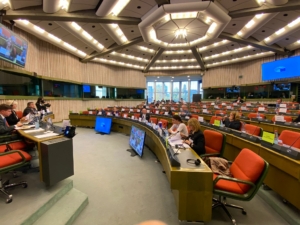 During the two-day exchange of views between the two Parliaments, MEP Joveva, as Co-Chair, started her address in Macedonian and then focused on the state of the media and civil society in North Macedonia, which she follows closely. She praised the improvement in terms of media freedom in the country, which has progressed to a better level compared to other countries in the Western Balkans region. She added that the country still had some way to go in the area of fighting disinformation and ensuring transparency of state institutions.
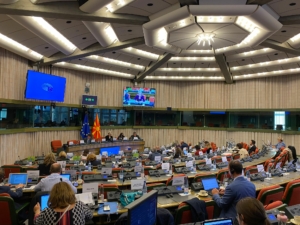 In conclusion, Joveva expressed her wish that the strategy for cooperation with North Macedonian civil society be implemented in a timely and transparent manner. She concluded her speech with the thought that the North Macedonian leaders should continue on the path of improvement strengthening an independent media, protecting journalists as well as the environment.
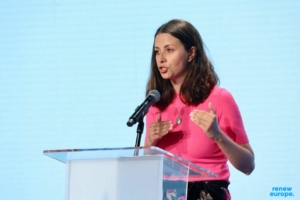 Joveva explained that the EU was founded on six values: human rights, freedom, democracy, equality, the rule of law and human dignity. “It is departing from these values that could potentially break the EU, as these values are becoming an increasingly popular target for attacks by leading actors of illiberal populism.”
 In her letter, she expressed her concern and disappointment with the situation, explaining that such practices are discriminatory and that multilingualism, both in the European Union and more broadly, is a value of which we can be proud and which should be promoted.
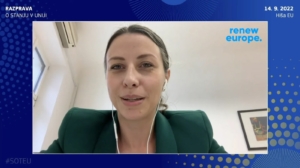 According to Joveva, what we have been hearing much too often are merely wishes and ideas on how the Western Balkans should become a part of the EU. She believes that the Commission President is right to touch on the Western Balkans in her annual State of the Union address, but she is also convinced that without shifts in the EU’s decision-making system, no progress can be achieved. She criticised the system of consensus required in the Council, where some Member State leaders often pursue narrow vested interests, while the European Parliament and the European Commission have no competence to decide on the progress of the Western Balkan countries towards EU accession.
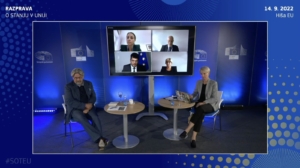 Nevertheless, Joveva praised the Commission President for highlighting in her speech the area of mental health, which does not receive attention it ought to. She expressed her satisfaction that the report on the impact of COVID-19 closures of educational, cultural, youth and sports activities on children and young people in the EU was expected to be adopted during this week’s plenary session, to which she contributed as a rapporteur on behalf of the Renew Europe group.